Import a pizza oven to the USA with Vesuviano Forni support
Import a pizza oven to the USA with Vesuviano Forni support
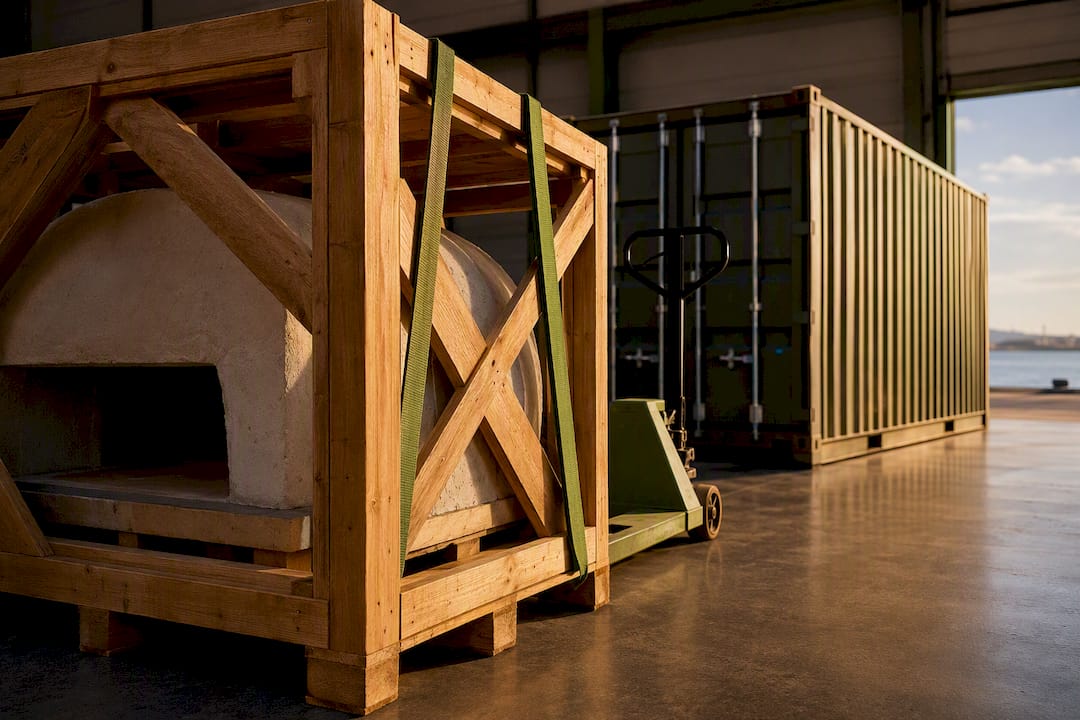
Yes, commercial pizza ovens can be imported into the United States, provided you secure the correct customs classification, complete paperwork and reliable logistics. The process is straightforward once you understand it, but skipping a step almost always means delays at the port. Start by preparing a bill of materials, supplier statements of origin and technical specifications, then contact a licensed customs broker or an export manager before you place your order.
TL;DR:
- Correct classification of the pizza oven depends on its use and construction, with duties varying significantly based on design and materials.
- Shipping large masonry ovens requires full container load (FCL), while smaller or metal units can benefit from less than container load (LCL) or air freight options.
- Proper documentation, including detailed commercial invoices, certificates of origin, and technical manuals, is essential to avoid delays or additional tariffs.
- Duty rates can shift due to HTS classification, country of origin, and current trade tariffs like Section 301, impacting the total landed cost.
- Clearing customs involves comprehensive paperwork review, with delays often caused by mismatches or vague descriptions, emphasizing early classification and documentation.
Table of Contents
- Import pizza oven to USA: which documents do you need?
- How does customs classify a pizza oven?
- Which shipping method suits a commercial oven?
- What compliance rules apply once the oven arrives?
- What does it cost and how long does it take?
- Do tariffs or trade agreements change the price?
- How do you clear customs once the shipment arrives?
- What happens after the oven is installed?
- Why the paperwork matters more than the port
- Vesuviano Forni: export, logistics and on-site assembly support for US buyers
- Sources
Import pizza oven to USA: which documents do you need?
Every successful import starts with a complete paper trail. U.S. Customs and Border Protection (CBP) officers work from documents, not intentions, so gaps or mismatches are the single biggest cause of held shipments.
Assemble these before your oven leaves the factory:
- Commercial invoice listing the seller, buyer, unit price, total value, currency, and a detailed product description. A vague entry like “oven” instead of “wood-fired Neapolitan pizza oven, refractory brick dome” invites a query from CBP.
- Packing list matching the invoice exactly, showing crate dimensions, weight and contents per package. Freight forwarders and CBP both cross-reference this against the manifest.
- Bill of lading (ocean) or airway bill (air freight), the legal shipping contract that proves who owns the goods in transit.
- Certificate of origin or supplier statement, confirming where the oven and its major components were manufactured. This document underpins any duty calculation.
- Technical datasheets, installation manuals and a materials list, which support the tariff classification and demonstrate the oven meets safety and construction expectations.
For ocean shipments, an Importer Security Filing (ISF) must reach CBP at least 24 hours before the vessel loads. If packaging includes wood pallets or insulation, check whether ISPM 15 treatment marks or EPA/USDA rules on packaging materials apply.
Pro Tip: Keep every component’s country of origin on a separate line of the invoice. A brick dome from Naples paired with an electric heating element from elsewhere in Europe needs to be documented individually, not lumped under one blanket origin statement.
How does customs classify a pizza oven?
Classification decides your duty bill, and pizza ovens sit in a genuinely ambiguous spot on the Harmonized Tariff Schedule (HTSUS). CBP typically separates two categories:
- Domestic-style appliances, often classified under heading 7321, which covers stoves, ranges and similar cooking appliances.
- Industrial or commercial cooking machinery, frequently falling under heading 8419, which covers equipment designed for processing materials by a change of temperature.
The dividing line is use and construction, not marketing language. A compact, portable unit aimed at home outdoor cooking reads differently to CBP than a walk-in commercial deck oven built for continuous restaurant service.
Country of origin adds another layer. CBP applies a “substantial transformation” test: has the finished oven acquired a new name, character or use compared with its component parts? A brick dome assembled from Italian refractory materials and finished in Naples clears that test differently to one shipped as raw parts and assembled elsewhere.
Two published rulings show how much classification can vary. CBP ruling N327554 classified a portable pizza oven from China under HTS 7321.11.1060, carrying a general duty of 5.7% ad valorem, with an additional Section 301 tariff of up to 25% potentially applying under Chapter 99 subheading 9903.88.03 for that origin. By contrast, CBP ruling N336751 found that a flat-pack wood-burning oven with a cordierite cooking chamber could fall under HTS 7116.20.4000, attracting a 10.5% duty in that specific factual scenario, because cordierite is treated as a semiprecious stone.
Rulings on identical-sounding products can land 20 percentage points apart in duty, purely because of construction and material differences.
If your oven’s classification isn’t obvious, request a binding ruling through CBP’s CROSS system, or ask a National Commodity Specialist to review your specifications before you commit to a shipment. Our guide to HTS codes for commercial ovens walks through how design details shift the outcome.
Which shipping method suits a commercial oven?
A 500kg brick dome behaves very differently in transit to a compact electric unit, and your shipping method should reflect that.
- Full container load (FCL) suits larger orders or heavy masonry ovens that need dedicated crating; you pay for the whole container but avoid the handling risk of shared space.
- Less than container load (LCL) works for smaller electric or metal-clad ovens, sharing container space with other cargo to cut cost, at the expense of a slightly longer transit.
- Air freight is fastest but expensive relative to weight, generally reserved for urgent single-unit orders or lightweight components.
Traditional wood-fired ovens built with brick and mosaic tile are often shipped disassembled, with the dome, base and finishing components crated separately and reassembled on site. Metal-slat or fully welded units can usually travel as a single crated piece.
Once the container clears the port, inland delivery needs planning too. Ask your freight forwarder about liftgate service if you lack a loading dock, and white-glove delivery if you want the crate placed inside the kitchen rather than curbside.
Incoterms determine who pays what: under DDP (Delivered Duty Paid) the seller handles duties and clearance, while under FOB or EXW that responsibility shifts to you as the buyer. Confirm this in writing before the invoice is issued, because it changes your landed cost calculation significantly.
Pro Tip: Insure the shipment for full replacement value, not just the invoice price. A handcrafted refractory dome damaged mid-Atlantic is not cheaply or quickly replaced, and standard carrier liability rarely covers the real cost of a bespoke oven.
What compliance rules apply once the oven arrives?
Clearing customs is only half the job. A pizza oven that passed the port inspection can still sit unused for weeks if it fails local permitting.
- Indoor commercial ovens generally need a grease duct and exhaust hood sized correctly for the appliance, reviewed by your local Authority Having Jurisdiction (AHJ) before installation.
- Electrical and gas connections must meet National Electrical Code (NEC) requirements and local gas codes, usually installed by a licensed contractor rather than general kitchen staff.
- Health departments expect clear equipment labelling and documentation showing the oven meets foodservice safety standards.
- Wood-fired ovens with visible soot output face closer scrutiny in emissions-conscious jurisdictions; low-emission designs tend to move through permitting faster.
- Keep every manual, test report and datasheet on hand. Inspectors ask for them, and a missing manual can stall a final sign-off that was otherwise routine.
Our ventless pizza oven compliance guide and installation requirements overview cover the venting and permitting detail in more depth.
Pro Tip: Call your local AHJ before the oven ships, not after. Venting requirements vary by city, and redesigning a hood system after installation costs far more than adjusting the plan on paper.
What does it cost and how long does it take?
Landed cost is never just the oven’s price tag. Budget for each line separately so nothing surprises you at delivery.
- Product cost (ex-works or FOB price from the manufacturer)
- Ocean or air freight charges
- Customs duties, calculated from the HTS classification and any applicable Chapter 99 or Section 301 additions
- Customs broker fees for entry filing
- Inland delivery, liftgate or white-glove service
- Installation and on-site assembly
- Cargo insurance
| Cost category | Typical range driver |
|---|---|
| Duty rate | Depends on HTS heading (7321, 8419 or 7116) and country of origin |
| Ocean freight | Container size, port pair and season |
| Broker fee | Entry complexity and shipment value |
| Installation | On-site assembly vs single-piece delivery |
Timelines run in stages: production lead time at the factory, ocean or air transit, customs clearance (usually a few days if paperwork is clean, far longer if it isn’t), then inland delivery and installation. A binding ruling requested early, a pre-classified HTS code and a consolidated shipment schedule all shave real time off that total. Staged delivery, ordering the dome ahead of finishing components, can also keep an installation team from waiting idle on site.
Do tariffs or trade agreements change the price?
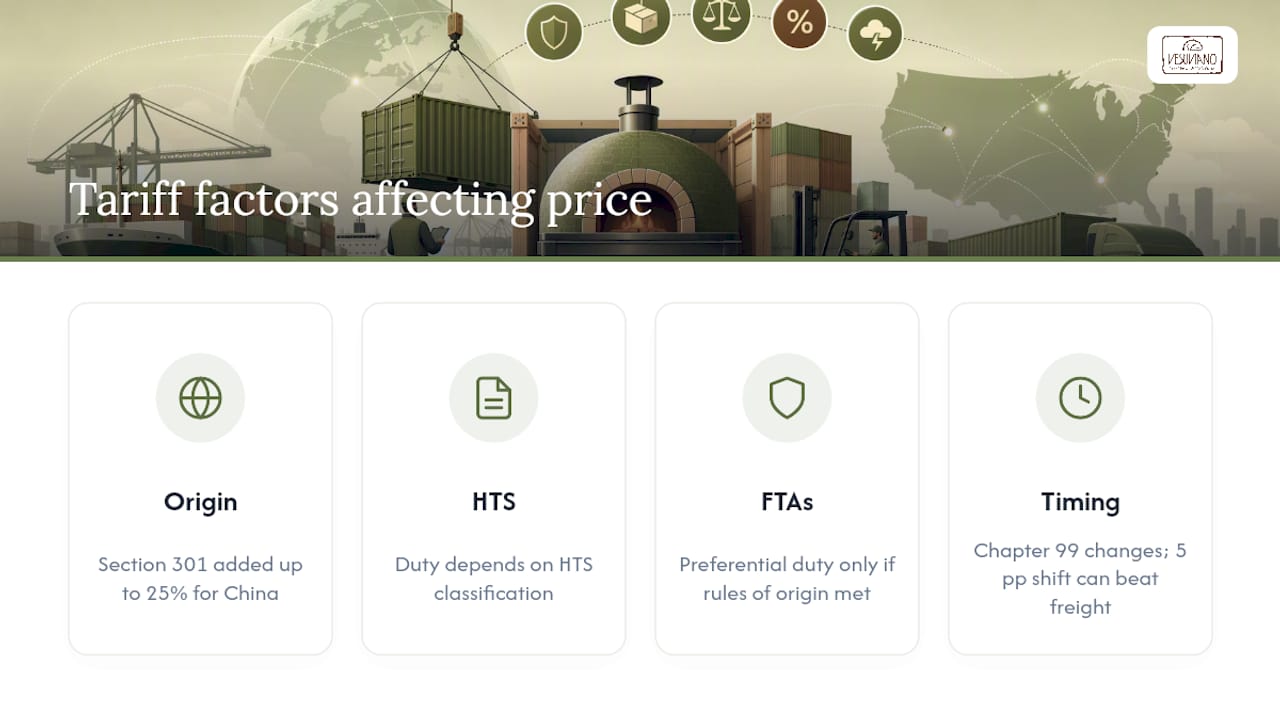
Duty rates on pizza ovens are not fixed. They shift with HTS classification, country of origin and whichever Chapter 99 provisions happen to be in force, so the number you saw quoted last year may already be out of date.
Section 301 tariffs, layered on top of standard duty for goods originating in China, have added as much as 25% ad valorem to some pizza oven classifications, as the N327554 ruling shows. That single fact makes country of origin one of the most consequential decisions in the entire import, well before you think about freight or installation.
Free trade agreements can offset this in specific cases. Goods qualifying for preferential treatment under an agreement the US has with the country of manufacture may enter at a reduced or zero duty rate, but only if the product meets that agreement’s rules of origin, not simply where it was shipped from. A refractory dome built and finished in Italy, for instance, follows a different tariff path to one assembled from parts sourced across several countries.
Because the Harmonized Tariff Schedule and its Chapter 99 notes are amended periodically, always confirm the current rate before finalising a purchase order rather than relying on a figure from a previous shipment or a competitor’s quote. A five percentage point shift in Chapter 99 status can move your total landed cost more than a change of freight carrier ever would.
How do you clear customs once the shipment arrives?
Clearance is a sequence, not a single event, and each stage depends on the paperwork prepared earlier in the process.
- The carrier files an arrival notice once the vessel or aircraft reaches port, triggering the customs clock.
- Your customs broker submits the entry summary to CBP, referencing the HTS classification, declared value and country of origin from your commercial invoice.
- CBP reviews the entry and may release the shipment immediately, or flag it for a document review or physical exam if something looks inconsistent.
- Duties, including any Chapter 99 additions, are paid, typically through the broker’s bond arrangement.
- Once released, the shipment moves to inland delivery, coordinated separately from the customs process itself.
Most delays trace back to mismatches: an invoice value that doesn’t match the packing list, a vague product description, or a classification that doesn’t hold up against the oven’s actual construction. A broker familiar with foodservice equipment spots these issues before filing, which is worth far more than a marginally cheaper quote from a generalist. If CBP does flag an exam, having the technical datasheets and materials list ready usually resolves it within days rather than weeks.
What happens after the oven is installed?
Import success doesn’t end at the loading dock. Warranty terms, repair access and spare parts availability decide whether your oven stays productive for the next decade.
Ask your supplier, before you order, exactly how warranty claims are handled from the United States. Some manufacturers require the oven to be shipped back to the country of origin for repair, which is impractical for a 500kg masonry structure. Others maintain a network of certified technicians or partner installers who can service the unit domestically.
Replacement parts are the quieter risk. A cracked refractory tile, a failing gas valve or a worn rotating mechanism are routine wear items on a busy commercial oven, and sourcing the exact part from overseas can mean weeks of downtime for a working kitchen. Confirm whether spare parts are stocked domestically or ship on demand, and get realistic lead times in writing rather than a vague assurance.
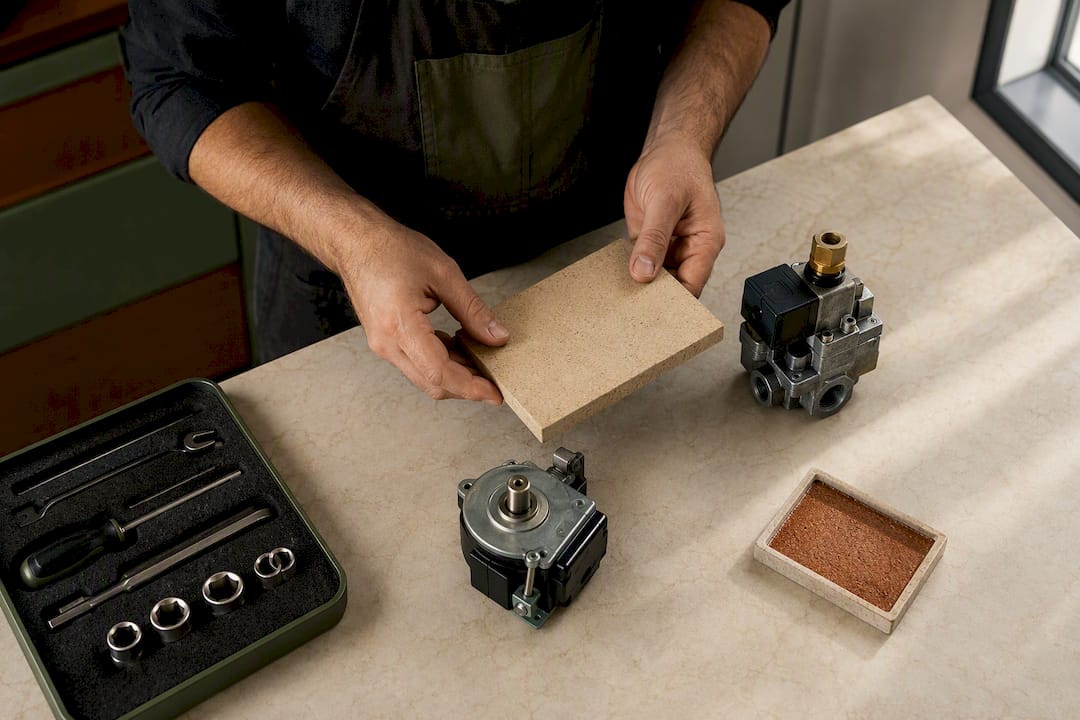
Documentation matters here too. The same manuals and test reports you kept for your local inspector double as the reference a repair technician needs to diagnose a fault correctly, so store them somewhere your kitchen staff can actually find them.
Why the paperwork matters more than the port
Most import guides focus on the shipping mechanics: containers, freight rates, transit times. That’s the easy part. The judgement call that actually determines your cost and your timeline happens weeks earlier, at the classification and documentation stage, long before any crate reaches a port.
Conventional advice treats HTS classification as an administrative formality to hand off to a broker. It isn’t. The gap between HTS 7321 and 8419, or the difference a cordierite component makes in ruling N336751, can swing landed cost by double digits. Get the classification wrong, or leave it vague on the invoice, and you inherit that risk regardless of how good your freight forwarder is.
What I’d prioritise differently: treat your bill of materials as the first deliverable of the project, not the last. Know the origin of every major component before you sign a purchase order, not after CBP asks. Buyers who choose manufacturers with real export experience, ones who’ve navigated custom-built installation projects before, tend to avoid the classification disputes that stall everyone else.
— Bruno - Key Account & Export Manager
Vesuviano Forni: export, logistics and on-site assembly support for US buyers
Importing a professional oven directly means owning every stage of this process yourself, from HTS classification to grease duct compliance. Vesuviano Forni exists for hospitality businesses who’d rather hand that complexity to a partner who has already solved it. Our team manages technical consultancy, custom oven design, international logistics, customs support and on-site assembly as one coordinated project, not a series of handoffs between strangers.
Our VesuvioBuono low-emission and soot-free ovens are worth a look if local permitting around emissions is a concern for your venue. To get an accurate export and shipping quote, we’ll need your kitchen layout, power or gas specifications, and any local venting constraints from your AHJ. Browse our Neapolitan pizza oven range and get in touch to request a site survey and a formal export quote for your project.
Sources
- CROSS Customs Rulings Online Search System (example ruling entry)
- CBP Ruling N327554: The tariff classification of a pizza oven from China. | TariffLens