Avoid a £15,000 upgrade: three-phase pizza oven for kitchen managers
Avoid a £15,000 upgrade: three-phase pizza oven for kitchen managers
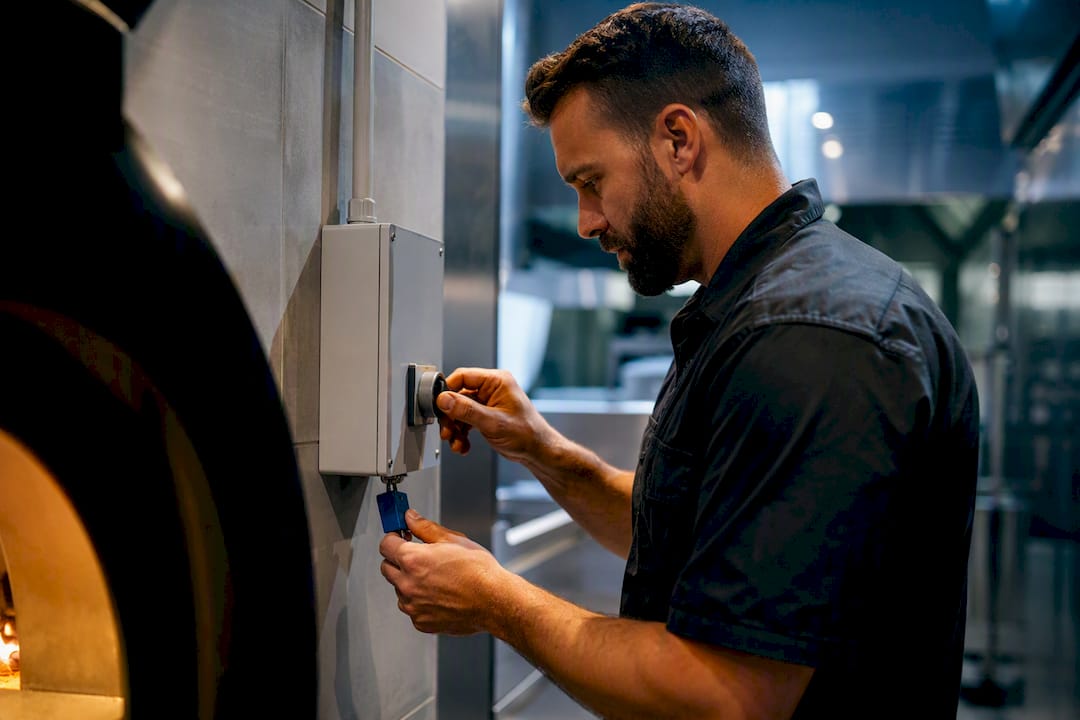
Choose a three-phase pizza oven when your premises has, or can affordably obtain, three-phase electrical service and your kitchen needs sustained high-volume output. If your site’s electrical capacity, panel space or budget rules out a three-phase upgrade, a single-phase or gas oven will bake to the same standard, though it comes with its own wiring demands.
TL;DR:
- A three-phase pizza oven offers significant electrical advantages if your site already supports or can affordably upgrade to three-phase power, reducing wiring costs and demand charges.
- Verifying your building’s voltage, phase, and panel capacity with a qualified electrician before ordering prevents costly mistakes and potential warranty voids.
- Installing a three-phase supply where none exists involves substantial costs, including new cabling, upgraded panels, and utility fees, which vary widely by region and existing infrastructure.
- Operational performance between single-phase and three-phase ovens is similar, but three-phase models recover faster and may feel more “intense” during high-volume service.
- Suppliers should provide detailed electrical data, wiring diagrams, and lead times upfront; hesitations or delays indicate potential issues with support or documentation.
Table of Contents
- What does three-phase power mean for a pizza oven?
- Electrical checklist before you order
- What drives installation and total running cost?
- How does phase choice affect day-to-day performance?
- What should you ask suppliers before you buy?
- Who’s behind this guidance, and how Vesuviano Forni supports buyers
- Why the “just buy three-phase, it’s better” advice misses the point
- Ready to specify your oven? Here’s how Vesuviano Forni helps
- Sources
- FAQ
What does three-phase power mean for a pizza oven?
Single-phase supply delivers power down one live conductor, so a high-output oven draws its full current through one main line. Three-phase splits that same load across three separate conductors, each carrying a third of the current at a steady, staggered rate. In the UK, that typically means a three-phase supply reading around 400 volts across phases, against roughly 230 volts for a standard single-phase circuit.
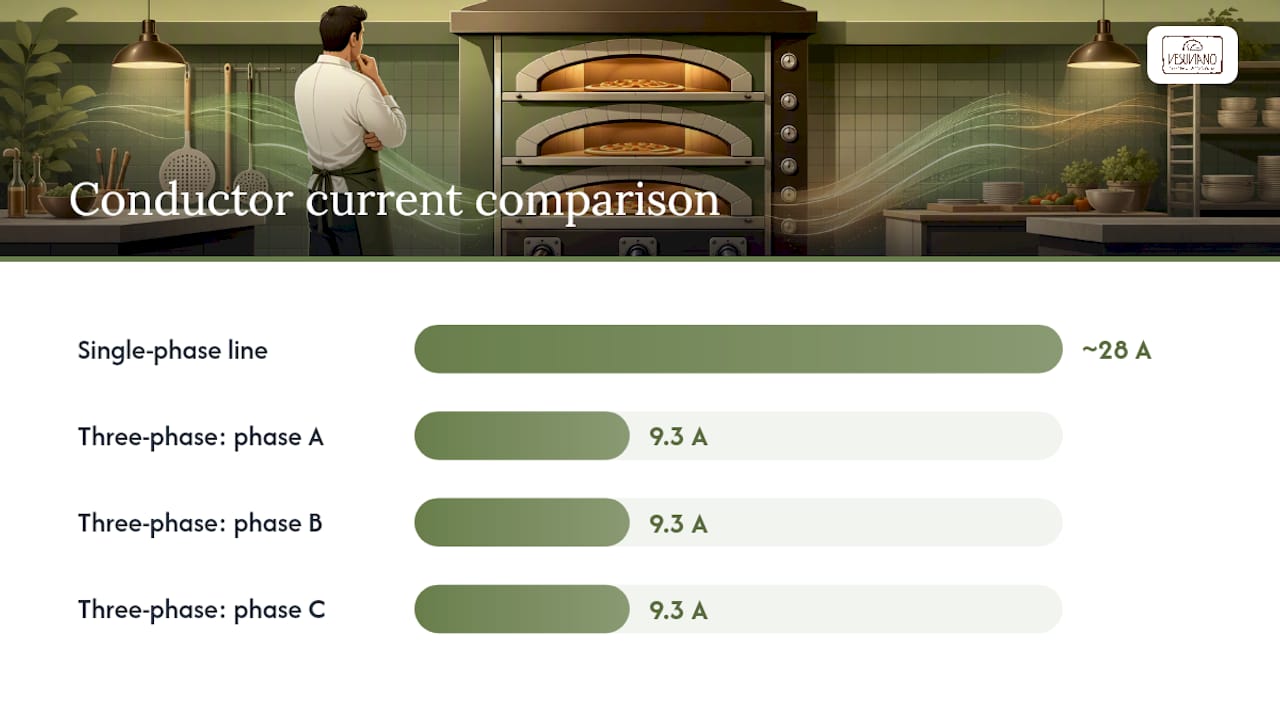
The practical benefit is amperage. A supplier listing for the Anvil POK0004 conveyor oven records a three-phase build drawing just 9.3 amps per phase at 400 volts, while the single-phase version of the same oven draws roughly 28 amps down one line. Same oven, same output, but the current is spread thin enough that thinner cable and a smaller breaker can often do the job.
This is why manufacturers frequently offer identical deck ovens in both phase configurations. The heating elements, refractory materials and cooking chamber are unchanged. What differs is purely how the electrical load reaches the oven, and that shows up on the spec sheet as:
- Voltage and phase configuration (single-phase 230V vs three-phase 400V)
- Total kW rating for the oven’s heating elements
- Amperage, either as one figure or broken down per phase
- Recommended breaker size and cable specification
Reading that spec sheet correctly, rather than assuming “more phases means more power”, is the first skill any buyer needs.
Electrical checklist before you order
Ordering a three-phase pizza oven for a site that cannot support it, or vice versa, is one of the most common and expensive mistakes in commercial kitchen procurement. Manufacturers are explicit that buyers must verify their building’s voltage and phase before placing an order, because the wrong specification can damage equipment and void a warranty outright.
Work through this sequence with your electrician before you commit to a model:
- Confirm whether three-phase supply already exists at the property, and get the exact voltage in writing from a qualified electrician, not a guess based on the building’s age or size.
- Ask your prospective supplier for the oven’s per-phase amperage, total kW draw and a wiring diagram, then check these against your panel’s spare breaker capacity.
- Establish whether the connection will be hard-wired or via a commercial plug, what conduit run is needed from panel to oven, and the correct fuse or breaker rating for that specific circuit.
- Ask your electrician to confirm whether your local network operator needs to upgrade the incoming supply, since this is a separate process from internal wiring work.
Pro Tip: Get the electrician’s sign-off in writing before you place a deposit with any supplier. A verbal “should be fine” from a contractor is not the same as a written confirmation of available amperage at your specific panel.
Skipping this checklist to save a week on lead time routinely costs far more than it saves, once a service upgrade or a returned oven enters the picture.
What drives installation and total running cost?
Three main variables decide what you’ll actually pay to get a three-phase oven running: the wiring itself, panel readiness, and utility connection charges. Copper cable is priced by length and cross-sectional area, and because three-phase reduces the current per conductor for a given kW output, wiring can often be cheaper to install than an equivalent single-phase run, provided the supply is already present at the property.
The picture changes sharply when three-phase supply doesn’t exist yet. Then you’re looking at a full service upgrade, which can involve:
- New cabling from the street or substation to your premises
- A larger consumer unit or distribution board with more breaker capacity
- Electrician labour for first and second fix work, testing and certification
- A utility connection fee, which network operators charge for new or upgraded supply and which varies by region and load requested
Because these costs swing so widely depending on what’s already in the ground, get at least three electrician quotes before signing off on any oven model. A £2,000 wiring job at one site can be a £15,000 service upgrade at another, purely down to what infrastructure already exists.
How does phase choice affect day-to-day performance?
Baking performance between single-phase and three-phase builds of the same oven model is functionally identical: the dough doesn’t know how many conductors fed the elements. What differs is recovery and how the heat behaves under sustained load. Operators on pizza-industry forums consistently report that three-phase ovens feel more “intense” and recover faster between bakes, which matters most during a Friday-night rush rather than during a quiet lunch service.

A kilowatt-hour is a kilowatt-hour, regardless of phase. What can change your bill is distribution loss, wiring efficiency and, critically, demand or maximum-demand charges that some tariffs apply based on peak draw. Ask your energy supplier how your tariff treats three-phase demand before assuming the running cost will mirror single-phase, and see our breakdown of electric oven energy use for typical pizzeria consumption patterns.
For day-to-day workflow, stagger your preheat rather than firing every deck simultaneously, manage door-open time during service to protect element life, and balance load across busy and quiet periods rather than running flat out continuously. A tariff review alongside your electrician’s advice will tell you whether time-of-use pricing changes how you should schedule preheat.
What should you ask suppliers before you buy?
A proper quote should answer every question on this list before you sign anything, not leave you chasing details after the deposit clears.
- Request the exact voltage, phase configuration and per-phase amperage, not just a single combined figure.
- Ask for total kW draw, recommended breaker size, and whether the unit is designed for hard-wire connection or a commercial plug.
- Get the oven’s footprint and deck capacity confirmed against your kitchen layout, including clearance for service access and heat dissipation.
- Ask for the electrical data sheet and wiring diagram in writing, ideally before your electrician’s site visit.
- Clarify lead times, warranty terms, and whether the supplier provides on-site installation or ongoing technical consultancy, or whether that’s arranged separately.
Suppliers who hesitate to provide a wiring diagram or electrical data sheet on request are worth treating with caution. This documentation exists for every commercial-grade oven, and a supplier that stalls on it is often stalling on details that matter.
Who’s behind this guidance, and how Vesuviano Forni supports buyers
This guide is written from the vantage point of Bruno, Key Account & Export Manager at Vesuviano Forni, whose work sits squarely at the intersection of oven specification and international logistics. Getting a three-phase electric oven from a workshop in Naples to a working kitchen abroad means answering exactly the electrical and installation questions raised throughout this guide, for every single project.
Vesuviano Forni brings together artisans with decades of experience in handcrafted Neapolitan oven construction, alongside a research and development team focused on electric, rotating and low-emission oven technology. That combination shapes how the brand supports buyers:
- Custom oven design tailored to a kitchen’s electrical service and available footprint
- On-site construction and assembly for complex or bespoke installations
- Technical consultancy that covers wiring requirements alongside oven specification
- Export logistics, customs clearance and after-sales support for international projects
Every kitchen’s electrical starting point is different, and that’s exactly why the checklist above matters more than any single spec sheet.
Why the “just buy three-phase, it’s better” advice misses the point
The most common piece of advice buyers hear is that three-phase is simply the superior choice, full stop. That’s not quite right, and it leads people to fixate on the wrong question. The real decision isn’t “which is better” but “which matches what my building can actually deliver without a five-figure service upgrade”.
Where conventional buying guides fall short is treating electrical capacity as a footnote rather than the deciding factor. A three-phase oven drawing a fraction of the amps per line is a genuine engineering advantage, but only once that supply already exists at your premises. If it doesn’t, you’re not comparing two ovens; you’re comparing an oven purchase against a separate infrastructure project with its own timeline and cost.
My honest view, shaped by watching plenty of export projects unfold: verify your panel capacity before you fall in love with a spec sheet. Kitchen managers who get the electrician’s written confirmation first, then shop for the oven, make faster and cheaper decisions than those who order first and troubleshoot the wiring afterwards.
— Bruno - Key Account & Export Manager
Ready to specify your oven? Here’s how Vesuviano Forni helps
A specialist brand builds handcrafted electric and mixed-fuel commercial ovens, backed by technical consultancy, custom design and on-site assembly for kitchens that need more than an off-the-shelf install. Whether your site already runs three-phase or you’re weighing up a service upgrade, getting the specification right from day one saves you from costly rework later.
The next step is straightforward: request a site electrical review with your electrician, ask us for a wiring diagram alongside a formal quotation, and arrange a site-measure appointment before any deposit changes hands. Browse the full electric oven range to see voltage and phase options across models, or explore the Anastasia, Real Bosco and Sebastian collections if you’re still comparing finishes and fuel types. For projects needing hands-on support, our consultancy and logistics services cover everything from 3D renders to installation, so your electrical checklist and your oven order move forward together, not in isolation.
Sources
- Cost to install three-phase power in the UK | EcoFlow Energy
- Electric Deck oven: Three Phase or One or is gas in my future? | PizzaMaking forum
- Anvil POK0004 Conveyor Pizza Oven 3 Phase 400V 9.3A/Phase | CKA
- PizzaMaster FAQ — Forza Pizza
- Restaurant electrical cost guidance | Elec‑Mate
FAQ
What’s the difference between a three-phase and single-phase pizza oven?
Both run on the same heating elements and produce identical baking results; the difference is purely electrical. A three-phase build spreads current across three conductors, which typically lowers per-line amperage compared with drawing the full load through a single-phase circuit.
Do I need three-phase power for a commercial pizza oven?
Only if your oven’s kW rating and amperage exceed what a single-phase supply can safely deliver, or if you want the faster recovery some operators report from three-phase builds. Many commercial ovens, including several in Vesuviano Forni’s electric range, are available in either configuration.
How much does it cost to install three-phase power in a commercial kitchen?
Costs vary widely depending on whether three-phase already reaches your property; installing it where it’s already present is often cheaper than a full service upgrade from scratch. Get several electrician quotes, since panel readiness and utility connection fees can shift the total significantly.
How do I check if my kitchen can support a three-phase oven?
Ask a qualified electrician to confirm your incoming supply voltage, phase configuration, and whether your panel has spare breaker capacity for the oven’s specific amperage. Suppliers routinely stress that confirming this before ordering is the single most important step in the buying process.
Does Vesuviano Forni offer three-phase electric pizza ovens?
Yes, Vesuviano Forni’s handcrafted electric oven range includes models suited to both single-phase and three-phase sites, alongside technical consultancy to confirm the right specification. Pricing is available on request through the collections and product pages.