Pro Pizza & Industrial Oven Insulation: 80–120mm Floors, 500°C
Pro Pizza & Industrial Oven Insulation: 80–120mm Floors, 500°C
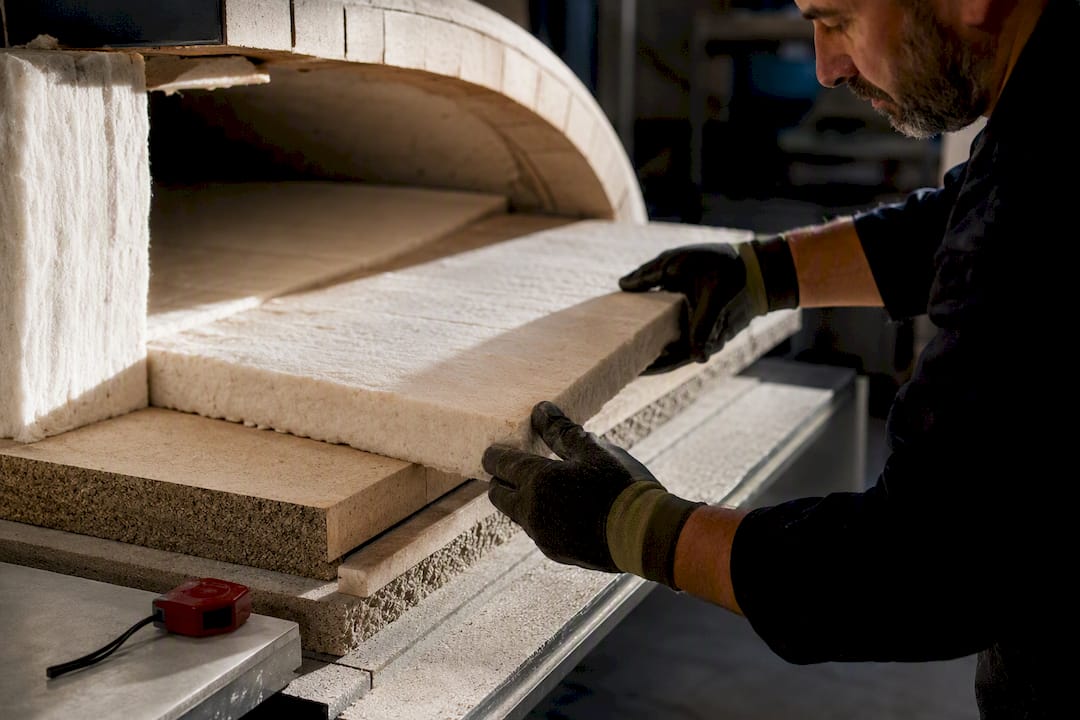
For oven insulation, choose materials rated for continuous high-temperature service, typically glass wool needled mat, ceramic fibre, vermiculite mixes, calcium silicate boards or perlite concrete. The right choice depends on where it goes: floor, dome or outer casing all carry different thermal and mechanical demands. Pick binder-free, low-VOC formulations for cooking ovens, and always check the continuous versus intermittent temperature rating before buying.
TL;DR:
- Insulation materials must be rated for high temperatures and match the specific location and mechanical demands of each oven zone to prevent early failure.
- Glass wool needled mats are ideal for cavity and casing insulation, while ceramic fibre suits domes and high-peak temperature areas due to thermal resilience.
- Proper installation requires sealing layers, moisture barriers, and staged curing to avoid cracking, especially with moisture-sensitive materials like vermiculite or perlite.
- Continuous temperature ratings differ significantly from intermittent ratings; selecting the correct value and considering thermal conductivity ensures thermal efficiency.
- Re-insulation should follow careful removal, proper replacement with high-rated insulation, and re-seasoning, with old fibrous waste disposed of according to regulations.
Table of Contents
- Common oven insulation materials and the forms they come in
- How hot can it get? Temperature ratings and thickness guidance
- Matching material to location: floor, dome, cavity and casing
- Getting the installation right: layers and moisture control
- Safety, emissions and the standards worth checking
- Where to buy oven insulation and what to expect on the shelf
- Spotting failing insulation and when to re-insulate
- Vesuviano Forni: specifying insulation on professional builds
- Why the right insulation is the quiet difference-maker
- Sources
- FAQ
Common oven insulation materials and the forms they come in
Every professional oven builder eventually has the same conversation with a client: “why does the floor need a different material to the dome?” The answer lies in how each of these materials behaves under sustained heat, moisture and mechanical load.
Glass wool needled mat is a lightweight, felted fibre product that has become the standard choice for cavity and casing insulation in cooking appliances. Binder-free variants are rated for continuous service at around 500°C, rising to 550°C intermittently, and were developed specifically to avoid the odour and VOC emissions that bonded fibre products can release when they first heat up. That matters enormously in a pizza oven, where any off-gassing near the cooking chamber is unacceptable.
Ceramic fibre blankets and boards sit at the top end of the temperature scale and are widely used in kilns, forges and high-performance pizza ovens. They retain heat exceptionally well and respond fast to temperature changes, which suits ovens that need rapid heat-up cycles. The trade-off is handling: ceramic fibre products shed fine fibres during cutting and installation, so they nearly always need a protective outer finish once fitted.
Vermiculite, either as loose-fill granules or mixed into a vermiculite-concrete screed, remains the go-to material for under-floor insulation. It is light, cheap relative to its performance, and does an excellent job of protecting a structural hearth from the thermal stress a wood-fired chamber generates. Its weakness is moisture: vermiculite absorbs water readily, and a damp mix that gets heated too quickly can crack or spall.
Calcium silicate and rigid insulating boards offer something the fibre products cannot: mechanical strength. They can be cut to precise dimensions and used as structural insulation in floors or service spaces where something needs to bear a load without crumbling. Supplier ranges built around ceramic fibre, vermiculite boards and rigid insulation boards consistently stress this point: pick the form for the duty, not just the maximum temperature on the label.
Perlite and perlite concrete function similarly to vermiculite mixes, poured or troweled into place beneath a hearth. It is generally lighter than vermiculite concrete but slightly less effective as a heat bank, so builders weigh density against how much residual warmth they want the floor to hold between bakes.
You will find all of these in a handful of physical forms: rolled blankets, rigid boards, bagged loose-fill, wet cast mixes, and thin ropes or papers used for sealing joints and doors. Matching the form to the job, not just the material name, is where most specification mistakes happen.
How hot can it get? Temperature ratings and thickness guidance
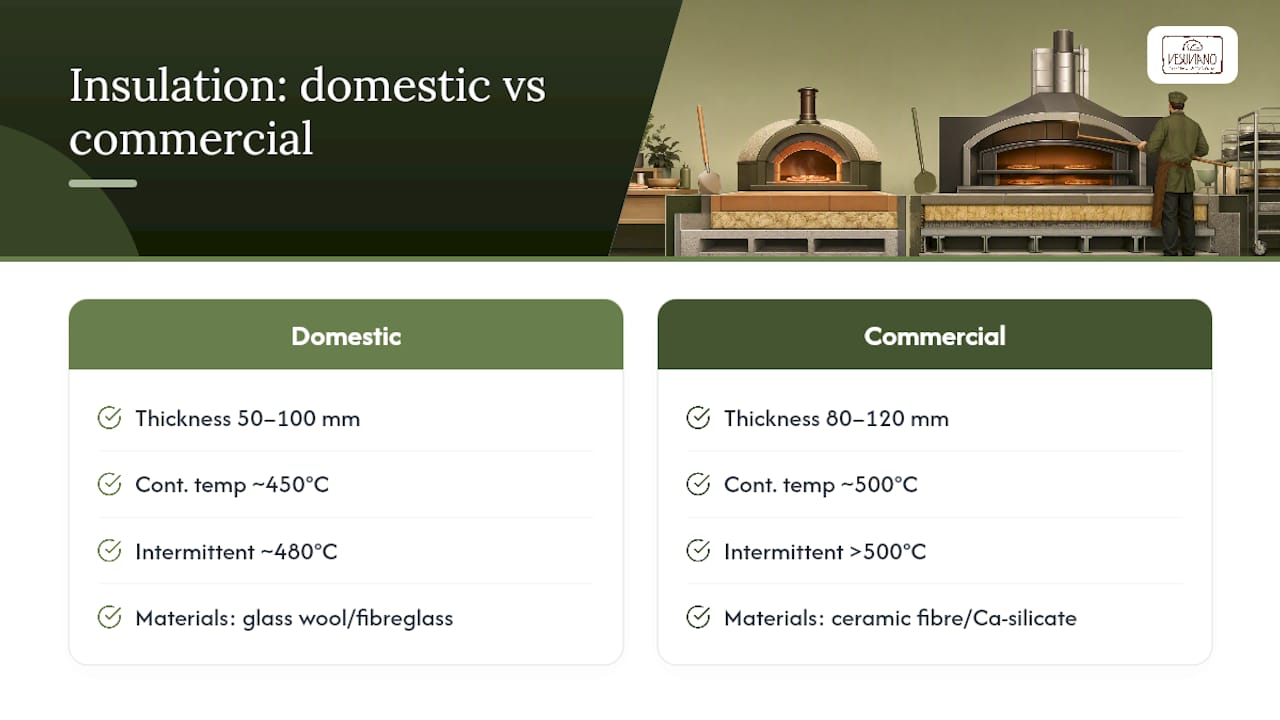
Every insulation product carries two temperature figures, and conflating them is a common and costly error. The continuous service temperature is what the material can withstand indefinitely; the intermittent rating covers short excursions above that, such as a pizza oven’s peak firing temperature during a busy service. A dome liner might sit permanently around 450°C but spike to 480°C for twenty minutes at a time, which is a very different demand to a floor slab holding steady heat for hours.
Glass wool needled mat, as noted above, is rated for continuous use at high temperatures typical for cooking ovens, with some capacity for short-term, higher heat exposure. Specialised high-temperature fibreglass blankets used in industrial appliances push further, with continuous ratings near 538°C, tested to standards including ASTM C411 and ASTM C1304, the latter specifically covering odour and emissions rather than heat tolerance alone. Ceramic fibre and calcium silicate products typically exceed both of these figures, which is why they dominate dome and flue applications where peak temperatures are highest.
Pro Tip: Don’t buy on the maximum temperature figure alone. A material rated to 1,000°C but with poor thermal conductivity can still lose you heat faster than a mid-rated product installed at the correct thickness.
Thermal conductivity, expressed as λ (lambda) in W/m·K, is the real efficiency measure. Lower conductivity at a given thickness means less heat escaping through the wall or floor. As a rough working range, cavity insulation in a domestic pizza oven typically runs 50 to 100mm thick, while commercial floors often call for 80 to 120mm beneath the hearth. Thicker is not automatically better: excess insulation under a firebrick floor can starve the surface of the thermal mass needed to hold consistent cooking heat, so thickness and heat bank behaviour have to be balanced together, not chosen in isolation.
Matching material to location: floor, dome, cavity and casing
Different parts of an oven fail in different ways, so the material choice for each zone follows its own logic rather than one blanket rule.
- Floor. Beneath the firebrick cooking surface, vermiculite-concrete or perlite mixes create a lightweight heat bank that protects the structural hearth from thermal shock. Builders generally choose between two strategies: a thick firebrick layer that stores its own heat, or a thinner brick sitting on a well-insulated base that recovers temperature faster between bakes. Rigid calcium silicate boards work here too, particularly where a level, load-bearing base is needed before the refractory bedding goes down.
- Dome and shell. This is ceramic fibre’s natural home. Layered blanket construction handles the rapid heating and very high peak temperatures a dome experiences far better than mineral wool, and its flexibility makes it easier to wrap around a curved shape.
- Cavity and external casing. Binder-free glass wool needled mat is the practical choice for the space between the dome and the outer shell, where the priority is energy efficiency, low odour and operator safety rather than extreme peak temperature. It also needs mechanical protection, usually a metal or render skin, since it is not designed to be load-bearing or exposed.
- Commercial and continuous-use ovens. Ovens running all day, every day, justify thicker layers, higher-rated materials throughout, and more robust protective outer finishes, since the cumulative thermal cycling is harsher than intermittent domestic use.
Pro Tip: If you’re specifying an oven for a high-turnover pizzeria rather than occasional home use, size the insulation for the recovery time between orders, not just the peak temperature. That is usually the difference between an oven that keeps pace during a Friday night rush and one that falls behind.
Getting the installation right: layers and moisture control
A well-insulated oven floor is built in a specific sequence, and skipping a layer is the single most common cause of early failure. A typical build-up runs: structural base, a moisture barrier, the insulation layer (vermiculite concrete, perlite, or rigid board), a refractory bedding layer, then the firebricks themselves.
Fitting blankets and boards correctly matters as much as choosing the right one:
- Stagger seams between layers so no single joint runs straight through the insulation.
- Compress ceramic fibre blankets as little as possible; over-compressing reduces the trapped air that gives the material its insulating value.
- Secure boards and blankets mechanically before adding any finish coat, rather than relying on the finish to hold them in place.
- Fit a protective outer layer, render, metal cladding or similar, to contain loose fibres and shield the insulation from knocks.
Vermiculite and perlite mixes need a curing period before the oven sees full heat. Rushing this, or firing an oven while the mix is still damp, is a leading cause of cracking and spalling, since trapped moisture converts to steam faster than it can escape through the structure. A slow, staged seasoning fire over several days, gradually increasing temperature, allows residual moisture to leave gently.
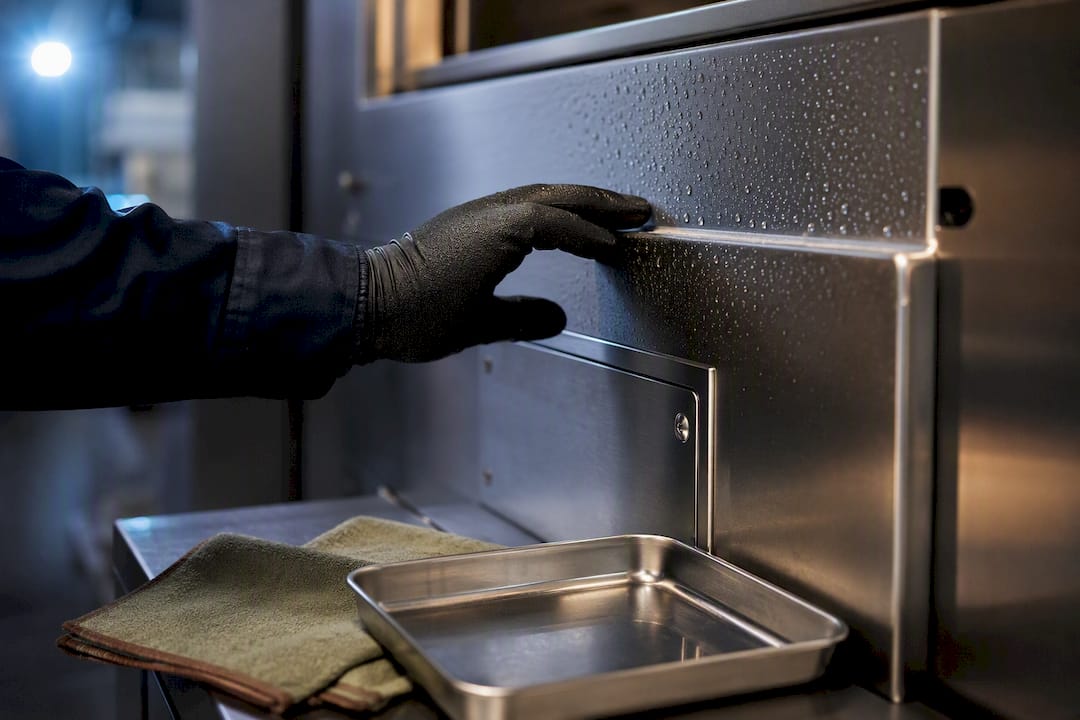
Pro Tip: Test for trapped moisture before your first full firing by checking for condensation on the outer casing during a low, gentle warm-up. If you see beading, hold at that temperature longer before pushing higher.
A vapour barrier beneath the insulation layer is not optional in most builds. Without one, ground or ambient moisture migrates upward into the vermiculite or perlite over time, quietly degrading performance long after installation.
Safety, emissions and the standards worth checking
Ceramic fibre and mineral wool products both require sensible handling: gloves, a dust mask and eye protection during cutting and fitting, since both shed fine particulate that irritates skin and airways. Once installed, encapsulating the material behind a protective finish, render, metal casing or refractory bedding, largely removes this concern for day-to-day oven use.
For any oven used to cook food, binder-free and low-VOC construction is non-negotiable. Bonded insulation products can off-gas during their first heat cycles, and testing regimes such as ASTM C1304 exist specifically to measure odour and emissions rather than temperature tolerance. When comparing products, look for certification marks such as EUCEB (confirming bio-solubility of the fibre) or RAL labelling, alongside the relevant EN or ASTM standard for the product category.
Call in a specialist when you are dealing with commercial compliance requirements, when the existing material in an older oven cannot be positively identified, or when structural cracking suggests the problem runs deeper than the insulation layer itself.
Where to buy oven insulation and what to expect on the shelf
Specialist high-temperature suppliers, kiln and pizza-oven retailers, and general insulation merchants all stock oven-grade materials, though stock depth varies widely between them. Look for these clues when comparing products:
- Blanket rolls are typically sold by thickness (25mm, 50mm) and density, with roll length and width stated separately.
- Rigid boards come in fixed thicknesses, often 25 to 50mm increments, sized for cutting to fit.
- Bagged vermiculite and perlite mixes state coverage area per bag at a given depth.
Before buying, confirm the continuous temperature rating, get a clear binder or VOC statement in writing, and ask for the recommended installation method rather than assuming one product fits every oven design.
Spotting failing insulation and when to re-insulate
An oven tells you when its insulation is failing, if you know what to look for. Rising fuel consumption for the same cooking output, a noticeably slower heat-up time, and hot patches on the external casing are the three earliest warning signs. Visible cracking, crumbling, or damp staining on cavity insulation confirms the diagnosis.
A quick visual inspection through any access panel, checking for compressed or displaced blanket, cracked board, or a musty smell suggesting trapped moisture, is worth doing annually on a commercial oven. Anything beyond surface wear on a business-critical appliance justifies bringing in a specialist rather than guessing.
Re-insulating follows a logical order: carefully strip back the outer finish, remove the degraded material, fit new insulation rated to at least the original specification, then re-cure and season the oven exactly as you would a new build, with a slow, staged firing schedule. Removed ceramic fibre or mineral wool should be bagged and disposed of according to the supplier’s data sheet and local waste regulations, since old fibre can be more friable than the fresh product.
Vesuviano Forni: specifying insulation on professional builds
When professional installers specify insulation for a commercial oven installation, three factors get weighed against each other every time: heat retention, the oven’s overall footprint, and how well the chosen material finishes under the chosen exterior, mosaic, metal slat or render. A ceramic fibre dome liner buys thermal performance but adds bulk that has to be accounted for in the design stage, particularly for export projects where crate dimensions and shipping weight matter.
On-site builds add another layer of practical decision-making: insulation thickness has to balance against logistics, curing time on location, and how the finish will be protected during transport and assembly. If you are planning a professional pizza oven and want a second opinion on insulation specification for your particular space, Vesuviano Forni’s technical consultancy and on-site construction service is built around exactly this kind of decision.
Why the right insulation is the quiet difference-maker
Get the insulation wrong and no amount of good dough or a skilled pizzaiolo will fix an oven that leaks heat, takes forty minutes to recover between bakes, or scorches its own casing. Balancing insulation performance against finish and weight is one of the least glamorous parts of building a professional oven, yet it decides fuel bills and lifespan more than almost any other single choice. A well-insulated oven simply costs less to run and lasts longer doing it.
— Bruno - Key Account & Export Manager
Sources
For further technical reading, see the ISOVER cooking ovens brochure, the Vitcas high-temperature materials range, and ASTM standards C411 and C1304.
- High-temperature insulation materials — Vitcas product family page
- Vermiculite pizza oven floor guide — StoneStyling
FAQ
What is the best insulation for an oven?
There is no single best material; the right choice depends on location and duty. Glass wool needled mat suits cavity and casing insulation, ceramic fibre suits domes needing high peak temperatures, and vermiculite or perlite mixes suit floors.
Where can I buy oven insulation?
Specialist high-temperature insulation suppliers, kiln and pizza-oven retailers, and general builders’ merchants with an insulation range all stock oven-grade materials. Confirm the continuous temperature rating and a binder or VOC statement before buying, since not all stock is suitable for food-contact cooking environments.
Can you re-insulate an oven?
Yes. Re-insulation involves carefully removing the old outer finish and degraded material, fitting new insulation rated to at least the original specification, then re-curing and seasoning the oven with a slow, staged firing schedule. Waste from old ceramic fibre or mineral wool should be disposed of following the supplier’s guidance, as aged fibre is often more friable than new product.
Do ovens need to be made with an insulating material?
Yes. Without adequate insulation, an oven loses heat faster than it can generate it, driving up fuel use and producing uneven, slow cooking results. Materials such as glass wool needled mat, ceramic fibre, vermiculite and calcium silicate boards exist specifically to keep that heat where the cooking happens.