Pizza oven installation cost for UK pizzerias: 2026 guide
Pizza oven installation cost for UK pizzerias: 2026 guide

A professionally installed Neapolitan pizza oven in a UK commercial kitchen typically costs several tens of thousands of pounds when you account for the oven itself, international logistics, on-site assembly, extraction infrastructure, and mandatory commissioning. The three items that most commonly blow budgets are ventilation and extraction plant sized to DW/172 and EN 16282, civil works for Class 1 flues or gas supply upgrades, and professional commissioning fees including Gas Safe certification. As industry guidance confirms, mandatory safety interlocks, specialised ductwork and professional commissioning are frequent hidden expenses that can substantially increase the installed cost beyond the oven’s sticker price.
- Ventilation and extraction: sizing to DW/172 and EN 16282 is non-optional and often the single largest line item after the oven itself.
- Fuel-type civil works: Class 1 flue routes for wood-fired ovens and gas main or LPG upgrades for gas models add significant structural cost.
- Professional commissioning and logistics: Gas Safe commissioning, electrical certification, customs clearance and specialist handling all carry real fees.
Pro Tip: When requesting quotes, ask every supplier to provide a fully installed price that itemises oven purchase, international freight, on-site assembly, extraction design, civil works and commissioning separately. A single lump-sum figure makes like-for-like comparison impossible.
Key takeaways
The total installed cost of a professional Neapolitan pizza oven in the UK typically ranges from £15,000 to £60,000+, with ventilation infrastructure, civil works and mandatory compliance certificates being the three items most likely to exceed initial estimates.
| Point | Details |
|---|---|
| Installed cost range | Budget £15,000–£60,000+ for purchase, logistics, extraction, civil works and commissioning combined. |
| Ventilation is the biggest variable | DW/172-compliant extraction sized to typical commercial rates per linear metre of hood is mandatory and often the largest single installation cost. |
| Compliance is non-negotiable | Gas Safe CP42, electrical certification and a fire risk assessment under the Regulatory Reform (Fire Safety) Order 2005 are required for insurance validity. |
| Early site survey saves money | Transit, doorway and service access problems are the most common and expensive issues to resolve; commission a survey before ordering. |
| Vesuviano Forni | Provides end-to-end UK project support: logistics, on-site assembly, extraction design brief and commissioning liaison from a single point of contact. |
Table of Contents
- What does pizza oven installation cost, line by line?
- UK regulatory checklist: what compliance costs you and why it matters
- How ventilation sizing drives your installation budget
- Site works that commonly add substantial cost
- What does the project timeline look like from order to first service?
- Running costs, servicing, and a simple payback calculation
- Where budgets go wrong and how to avoid it
- How Vesuviano Forni supports UK installations
- What I see operators get wrong — and the one thing that fixes it
- Vesuviano Forni: a full-service partner for your UK installation project
- Sources
What does pizza oven installation cost, line by line?
Breaking the project into discrete line items is the only reliable way to compare supplier quotes and build an accurate capital request.
Purchase price
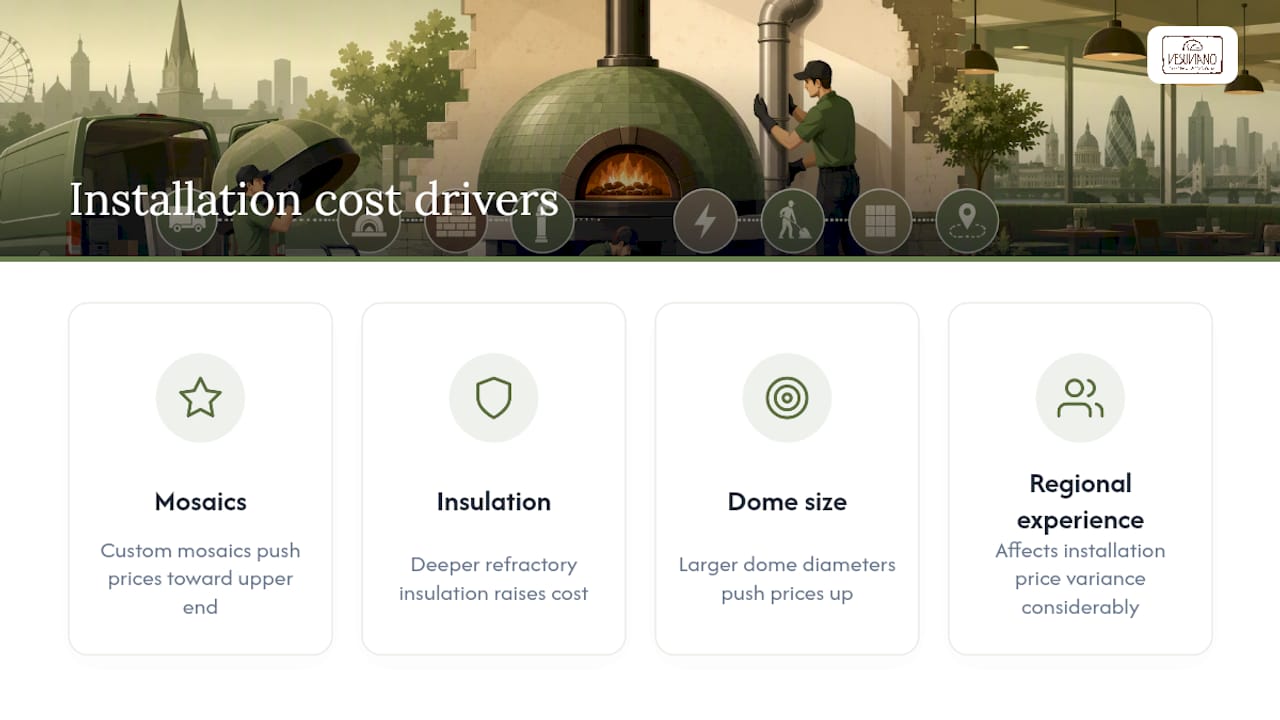
Custom mosaics, deeper refractory insulation, and larger dome diameters push prices toward the upper end. Regional contractor experience also affects installation price variance considerably.
Installation and infrastructure line items
Pro Tip: Ask every installer to confirm in writing whether extraction design, fire-stopping, and commissioning are included or excluded. Vague scope is the most common source of surprise invoices.
UK regulatory checklist: what compliance costs you and why it matters
Compliance is not optional, and the certificates below directly affect your insurance validity and your ability to trade.
- Gas Safe commissioning and CP42 certificate: UK law requires gas-fired catering equipment to be inspected by a Gas Safe registered engineer annually. The CP42 certificate is mandatory for insurance validity and workplace safety compliance.
- Electrical installation certificate: any new or modified electrical circuit serving the oven or extraction plant requires certification under BS 7671.
- Fire risk assessment: required under the Regulatory Reform (Fire Safety) Order 2005, particularly where a new heat source or flue is introduced. Installing a commercial pizza oven can also trigger premises licence changes.
- DW/172 (BESA) and EN 16282: the reference specifications for extraction system design. The full DW/172 document costs £500 from BESA for non-members. DW/144 and TR/19 cover duct hygiene and cleaning standards.
- BS 6173 and IGEM/UP/19: gas installation and CO₂ safety guidance for catering kitchens. IGEM/UP/19 sets a CO₂ threshold of 2,800 ppm where gas appliances are present, which directly determines your extract sizing requirement.
- DEFRA smoke-exemption: solid-fuel ovens in smoke control areas require a DEFRA-approved appliance or a specific exemption. Outdoor commercial use may also require a premises licence change.
- Planning and landlord consent: listed buildings and conservation areas impose additional restrictions on flue penetrations. Always obtain landlord written consent before structural works begin.
- Appliance certification: confirm UKCA or CE conformity and that the appliance is rated for indoor commercial use. NCASS guidance warns that adapting consumer or outdoor-only appliances for indoor commercial use voids certification and invalidates insurance.
Pro Tip: Sequence compliance in this order: site survey → extraction design → building control notification → Gas Safe commissioning → fire risk assessment. Starting extraction design before the site survey is the most common cause of costly rework.
How ventilation sizing drives your installation budget
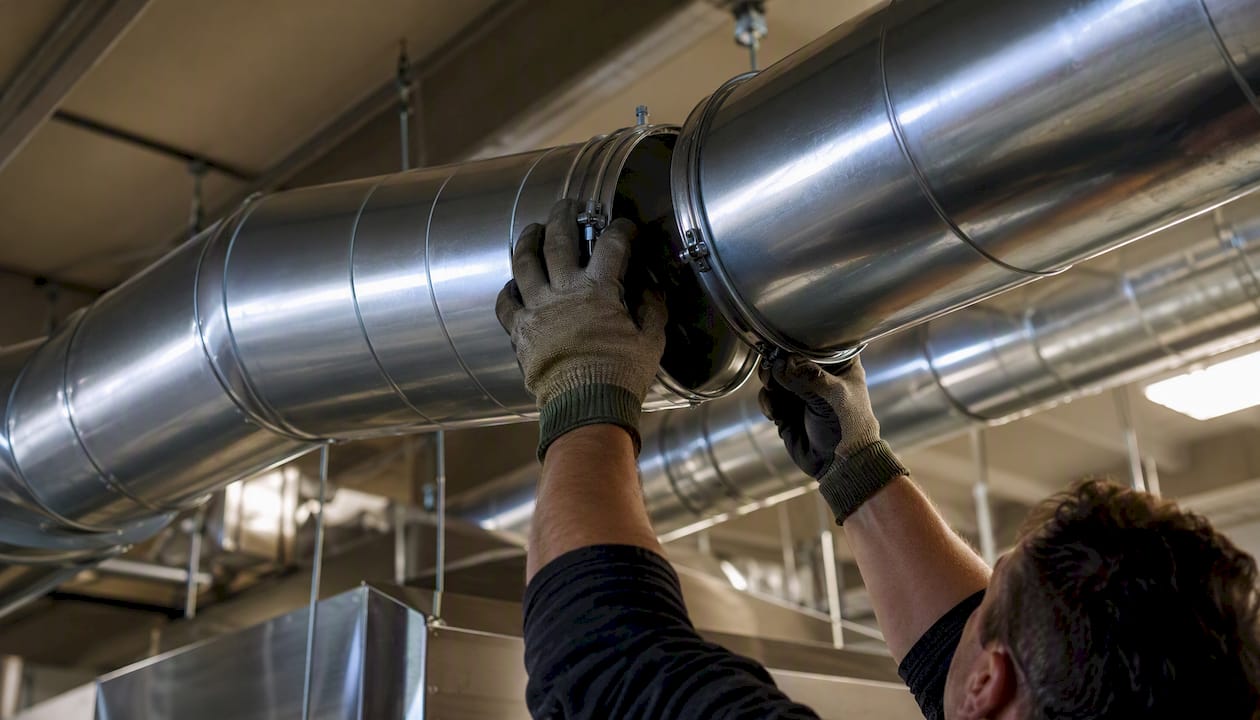
Extraction is where many operators receive their biggest budget shock. DW/172 and EN 16282 translate cooking duty into extract rate, and for a Neapolitan pizza oven the duty is high. Typical extract rates run from low to high volumes per linear metre of hood depending on cooking intensity — a range that determines fan size, duct diameter, attenuator specification, and whether odour abatement is required.
Assumptions: single-storey duct route, no odour abatement, standard attenuator. Costs rise with duct length, roof penetration complexity, and noise or odour control requirements.
Planning guidance on odour and noise from kitchen exhausts identifies carbon filtration, silencing and duct routing as distinct cost areas that may be required to obtain planning approval or resolve neighbour objections. In urban locations, these items alone can add £3,000–£10,000 to the extraction budget.
Many installers summarise only parts of DW/172, which can result in under-sized designs if the full document is not consulted. Always ask your extraction contractor to confirm they have designed to the complete specification.
Pro Tip: Commission the extraction design before finalising your oven position. Moving the oven by half a metre after ductwork is routed can cost more than the design itself.
Site works that commonly add substantial cost
Civil and structural works are routinely quoted separately from the oven supply, yet they are among the most variable cost items on any project.
Common structural items:
- Reinforced concrete plinth or steel base (load-bearing capacity for a handcrafted dome can exceed 800 kg)
- Roof penetrations and fire-stopping for Class 1 flue routes
- Chase routing for vertical duct through multiple floors
- Bespoke canopy or enclosure construction
- Protective screening and fire-rated cladding around the flue
Logistics and access:
- Transit route audit (door widths, corridor turns, stairwell clearances)
- Crane or hi-lift hire for upper-floor or rooftop installations
- Removal of existing equipment and temporary trading disruption
Before booking a site survey, confirm the following: minimum door width of 900 mm on the delivery route; ceiling height of at least 2.4 m at the oven position; confirmed roof access for flue or duct penetration; lease clause permitting structural alterations; and utility availability (gas, three-phase power, or both) within 3 m of the oven position.
Pro Tip: Commission a site survey and measured drawings before placing your oven order. Manufacturers and installers consistently report that transit, doorway and service access problems are the most common and expensive issues to resolve on-site.
What does the project timeline look like from order to first service?
- Enquiry and site survey (1–2 weeks): kitchen dimensions, utility availability, structural assessment and extraction design brief.
- Design, specification and quote (1–3 weeks): bespoke oven design, extraction engineering, compliance checklist.
- Manufacture or shipping lead time (6–14 weeks for handcrafted imported ovens; shorter for stock models): custom mosaics and on-site builds extend this stage.
- Site preparation (1–4 weeks): plinth construction, flue route, electrical and gas works.
- Installation and ducting (3–7 days on-site for a standard single oven).
- Commissioning and certification (1–3 days): Gas Safe sign-off, electrical certification, fire risk assessment sign-off.
The most common scheduling risk is late planning conditions or landlord consent, which can delay site preparation by weeks. Ordering made-to-measure mosaic finishes or commissioning an on-site build adds 4–8 weeks to the manufacture stage.
Running costs, servicing, and a simple payback calculation
Fuel cost comparison (directional assumptions — verify current tariffs)
- Wood-fired: fuel cost depends on hardwood log quality and supplier; typically £80–£200 per week for a busy single-oven pizzeria. No gas standing charge, but flue sweeping (twice yearly minimum) adds £150–£300 per year.
- Gas: consumption depends on oven size and service hours. Gas-fired Neapolitan ovens are generally more controllable than wood, with lower labour cost per shift. Annual CP42 inspection: £300–£700.
- Electric: three-phase supply required; no flue cost, but electricity unit rates in the UK make high-throughput electric operation more expensive per pizza than gas at current tariffs. No annual gas inspection fee.
Servicing schedule
- Gas Safe CP42 annual inspection (gas models): mandatory
- Extraction fan service: annually
- Flue sweep (wood-fired): at least twice yearly
- Electrical PAT testing: annually or per insurer requirement
- Spare parts contingency: budget 1–2% of oven purchase price per year
Worked payback example
Gross margin per pizza: approximately £8.64. At 80 pizzas per service and 5 services weekly, weekly gross contribution from pizza is approximately £3,456. At that throughput, the capital cost recovers in roughly 9 weeks of pizza gross margin — before labour, rent and other overheads. The real payback question is therefore throughput consistency, not fuel cost.
Pro Tip: When modelling ROI, include downtime risk. A wood-fired oven with no spare-parts SLA from your supplier can mean days of lost service if a refractory component fails. Factor in your supplier’s parts availability and response time before signing.
Where budgets go wrong and how to avoid it
Common hidden costs
- Gas interlock systems (mandatory for gas ovens in commercial kitchens)
- Odour abatement plant (carbon filters, UV systems) triggered by planning or neighbour objections
- Three-phase electrical supply upgrade (often £2,000–£6,000 if not already present)
- Additional structural works discovered during installation
- Neighbour mitigation for smoke or noise
- Planning or licensing conditions imposed after submission
Procurement checklist
Before awarding a contract, confirm in writing:
- Full itemised scope (oven, freight, assembly, extraction, civil works, commissioning)
- Warranty terms and what voids them
- Who procures and installs the extraction plant
- Lead times and penalty clauses for delay
- Commissioning inclusions (Gas Safe, electrical, fire risk)
- Exclusions list (what the supplier will not do)
Red flags in quotes: vague scope descriptions, no site survey included, missing certification line items, and a single lump-sum price with no breakdown.
Procurement workflow
- Commission a site survey and measured drawings before requesting quotes.
- Issue a detailed brief specifying fuel type, oven size, extraction duty and compliance requirements.
- Request fully itemised quotes from at least two suppliers.
- Compare line by line, not total price.
- Confirm commissioning and certification inclusions in the contract before signing.
- Retain 5–10% of the contract value until commissioning certificates are issued.
Pro Tip: Package pricing (oven + extraction + commissioning from one supplier) reduces scope-gap risk. Ask whether your supplier can manage the extraction contractor directly or provide a single point of accountability.
How Vesuviano Forni supports UK installations
Vesuviano Forni provides a complete end-to-end service for UK operators, covering every stage from initial enquiry to post-installation support.
Services included in a standard UK commercial project:
- Site survey and technical consultancy
- Bespoke oven design (custom mosaics, dome diameter, fuel type)
- International logistics, customs clearance and transport to site
- On-site assembly and installation
- Extraction design support aligned to DW/172
- Gas Safe commissioning liaison
- After-sales servicing and spare parts supply
| Typically included | Typically excluded (local scope) |
|---|---|
| Oven manufacture and quality control | Local structural works (plinth, roof penetration) |
| International freight and customs clearance | Local planning and licensing fees |
| On-site assembly and commissioning support | Local Gas Safe engineer fees |
| Extraction design brief and specification | Local extraction contractor procurement |
| After-sales support and spare parts | Local electrical upgrade works |
Vesuviano Forni’s handcrafted Neapolitan ovens span the RealBosco, Sebastian and VesuvioBuono ranges, covering wood-fired, gas, electric and rotating platforms. For buyers weighing wood-fired installation implications specifically, the wood-fired oven cost guide covers flue and solid-fuel compliance in detail.
Pro Tip: Have your kitchen layout drawing, door-width measurements, utility availability (gas pressure, electrical phase) and preferred fuel type ready before your first call. This allows Vesuviano Forni’s team to provide a meaningful technical quote at the first meeting rather than a ballpark estimate.
What I see operators get wrong — and the one thing that fixes it
The most consistent mistake I see from operators planning a Neapolitan oven installation is treating the oven purchase price as the project budget. By the time extraction, civil works, commissioning and compliance are added, the total installed cost is routinely two to three times the oven’s sticker price. The single action that saves most clients significant money is commissioning a proper site survey before placing the oven order. It sounds obvious, but the majority of projects that run over budget do so because scope was agreed before anyone had measured the door widths, checked the gas pressure, or confirmed the roof access for the flue route.
Vesuviano Forni: a full-service partner for your UK installation project
Getting a handcrafted Neapolitan oven from Naples to a working UK kitchen involves more moving parts than most operators anticipate: export documentation, specialist freight, on-site assembly, extraction engineering, and a chain of compliance sign-offs. Vesuviano Forni manages all of it from a single point of contact, so you are not coordinating between a manufacturer, a freight forwarder, an extraction contractor and a Gas Safe engineer independently.
The RealBosco, Sebastian and VesuvioBuono ranges cover every fuel type and aesthetic, from traditional handcrafted mosaic domes to low-emission wood-fired models suited to smoke control areas. Every project begins with a technical site consultation to confirm scope, extraction duty and compliance requirements before a price is agreed.
Request a technical quote or site survey through the Neapolitan pizza ovens page. Have your kitchen layout, door measurements, and utility details to hand and Vesuviano Forni’s team will provide a fully itemised installed cost at the first meeting.
This article is general information, not a substitute for advice from a qualified lawyer. Consult a qualified legal professional about your own circumstances before acting on anything here.
Sources
- Gas vs Electric Commercial Oven Cost: The 2026 UK Chef’s Guide to Smart Kitchen Investment — Island Catering
- Wood-Fired vs Gas Pizza Ovens for Small Businesses — Catering Insurance
- Control of odour and noise from commercial kitchen exhaust systems — planning guidance
- Statement about the use of Gozney pizza ovens — NCASS