Installers: Match Oven Rating Plate to 37 mbar Regulators and Hoses
Installers: Match Oven Rating Plate to 37 mbar Regulators and Hoses
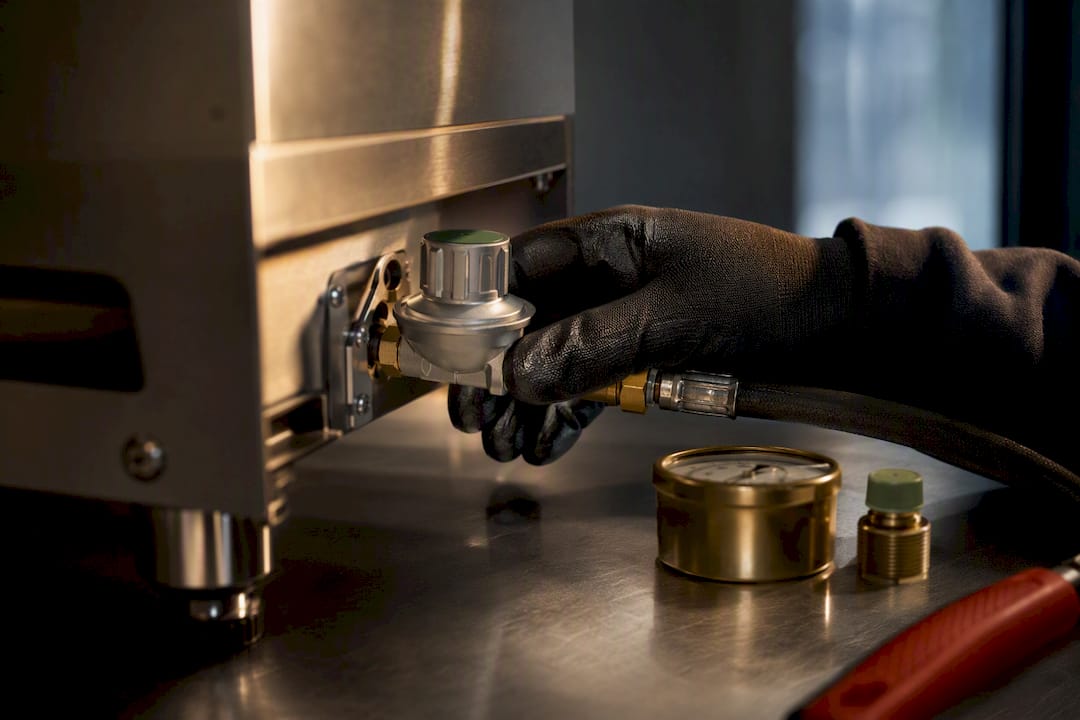
Every gas pizza oven has a nominal outlet pressure printed on its rating plate, and that figure, not guesswork, dictates which regulator you fit. Butane typically runs at 28–30 mbar, propane at 37 mbar, with some appliances specifying 30 mbar or 50 mbar variants depending on regional certification. Check the plate first, never connect to an unregulated source, and have a competent engineer verify and commission the installation before firing up the oven.
TL;DR:
- Most pizza ovens in Europe are certified for 28–30 mbar butane or 37 mbar propane, matching European testing standards for consistent combustion.
- Regulators must meet BS EN 16129:2013 standards and be marked on the device, not just the packaging, to ensure compliance and safety.
- Proper installation requires verifying the rated pressure, gas category, injector size, and heat input directly from the appliance rating plate before selecting regulators and hoses.
- System-level flow capacity matters as much as pressure, necessitating commissioning tests under full load to confirm manifold pressure, regulator capacity, and pipework adequacy.
- Incorrect pressure, whether too high or too low, can cause safety hazards and uneven cooking; regular maintenance, pressure checks, and inspection of joints are essential for safe operation.
Table of Contents
- Gas categories and standard nominal pressures for pizza ovens
- Regulators, standards and certification you must look for
- How do I match the rating plate to a regulator and hose?
- Why does system-level flow capacity matter as much as pressure?
- What happens if the gas pressure is wrong?
- What our artisans and engineers confirm on every commission
- A short word on getting this right
- Getting your installation professionally commissioned
- Key standards, regulations and manuals to consult
- Sources
- FAQ
Gas categories and standard nominal pressures for pizza ovens
Most commercial pizza ovens sold in the UK and across Europe are certified under the I3+ category, which covers butane at 28–30 mbar and propane at 37 mbar. These figures are not arbitrary. They reflect decades of harmonised European testing designed to match burner injector sizing with a specific, predictable outlet pressure, so combustion stays clean and repeatable across different cylinder or bulk tank setups.
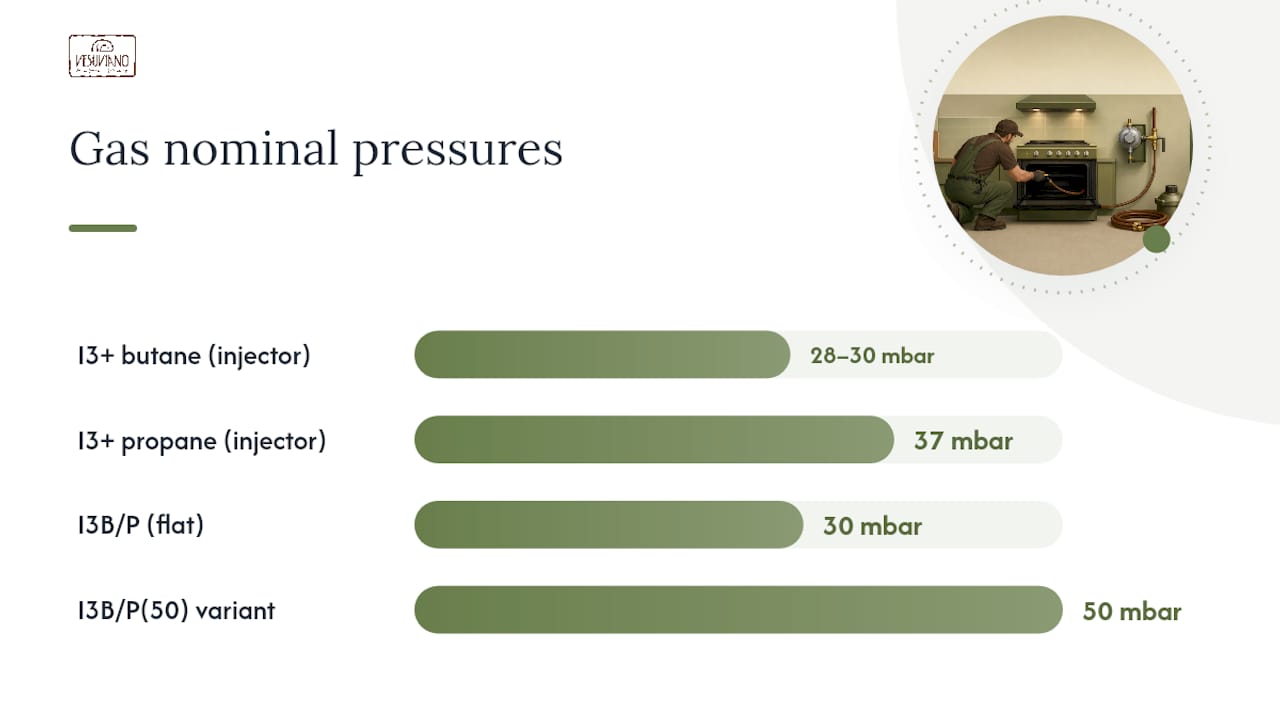
You will also encounter I3B/P appliances, which run at a flat 30 mbar regardless of whether butane or propane is in the cylinder, and I3B/P(50) variants set at 50 mbar. These categories exist because some markets and appliance designs prefer a single pressure that works across both gas types, simplifying regulator stock for installers who service mixed fleets.
Converting between units helps when you are reading an imported manual or an older gauge:
- 1 mbar equals roughly 0.0145 psi, so 37 mbar sits at approximately 0.54 psi.
- 1 psi equals roughly 68.9 mbar, meaning even a small psi reading translates to a large mbar swing.
- Pressure gauges calibrated in inches of water column convert at roughly 1 mbar to 0.401 inches wc.
Tolerances matter here. A regulator’s declared set pressure typically has an acceptable variance of a few millibars either side, which is why appliance manufacturers test burners against a range rather than a single fixed point. If your oven lists two categories on its plate, that usually signals it has been certified for multiple markets, each with its own permitted gas and pressure combination, and the injector fitted at the factory will match one of them, not both simultaneously.
Regulators, standards and certification you must look for
A regulator’s job is to step gas down from cylinder or bulk tank pressure, which can run into several bar, to the low, stable millibar range your oven’s burner actually needs. Getting this stage wrong undermines everything else in the system, no matter how well the pipework or the oven itself is specified.
Two standards dominate the UK and European market for LPG regulators:
- BS EN 16129:2013 covers automatic and adjustable regulators, setting requirements for mechanical strength, soundness and endurance, including cycle testing and leak rate limits measured in cubic centimetres per hour.
- BS EN 12864 / BS 3016 references apply to fixed, non-adjustable low-pressure regulators commonly used on domestic and light commercial cylinder connections.
Pro Tip: Look for the BS EN 16129 mark stamped directly onto the regulator body, not just printed on the packaging. Packaging gets discarded; the mark on the device is what an inspector or your own maintenance log will need years later.
Industry technical guidance in the UK also recommends a practical minimum operating pressure of around 32 mbar for propane regulators, slightly above the nominal 37 mbar setpoint’s lower tolerance band. That margin exists to keep burner ignition reliable even when line losses or cold weather pull pressure down slightly under load. Never fit a regulator without visible certification markings, and always ask your supplier for the declared kg/h capacity rating alongside the set pressure figure.
How do I match the rating plate to a regulator and hose?
The appliance rating plate is the single source of truth for your installation. Find it on the rear panel or beneath the control fascia, and confirm four things before ordering any equipment.
- Nominal pressure — the exact mbar figure the burner was designed and tested against.
- Gas category — I3+, I3B/P(30) or I3B/P(50), which tells you which fuels are permitted.
- Injector size — usually stamped in millimetres, this determines gas flow rate at the stated pressure.
- Heat input — the kW rating, which your regulator and hose must be capable of supplying without excessive pressure drop.
Once you have those figures, select a regulator with an outlet pressure that matches the plate precisely and a capacity rating comfortably above the oven’s peak demand. Use certified LPG hose rated for the working pressure, keep hose runs within the manufacturer’s stated length limit, and secure every connection with the correct crimped or captive clamp rather than a generic jubilee clip. Before lighting the burner, brush every joint with a soapy water solution and watch for bubbles. A visual check of the hose for cracking, chafing or perishing takes thirty seconds and catches problems a pressure test alone might miss.
Why does system-level flow capacity matter as much as pressure?
Nominal pressure only tells half the story. An oven can show a perfect 37 mbar reading at idle and still starve for gas the moment you fire multiple burners or run at full heat, because the real constraint is flow capacity, not static pressure. Pressure drop across the meter, pipework, hose and regulator all combine under load, and if any one component is undersized, the burner manifold sees a lower effective pressure exactly when the oven needs it most.
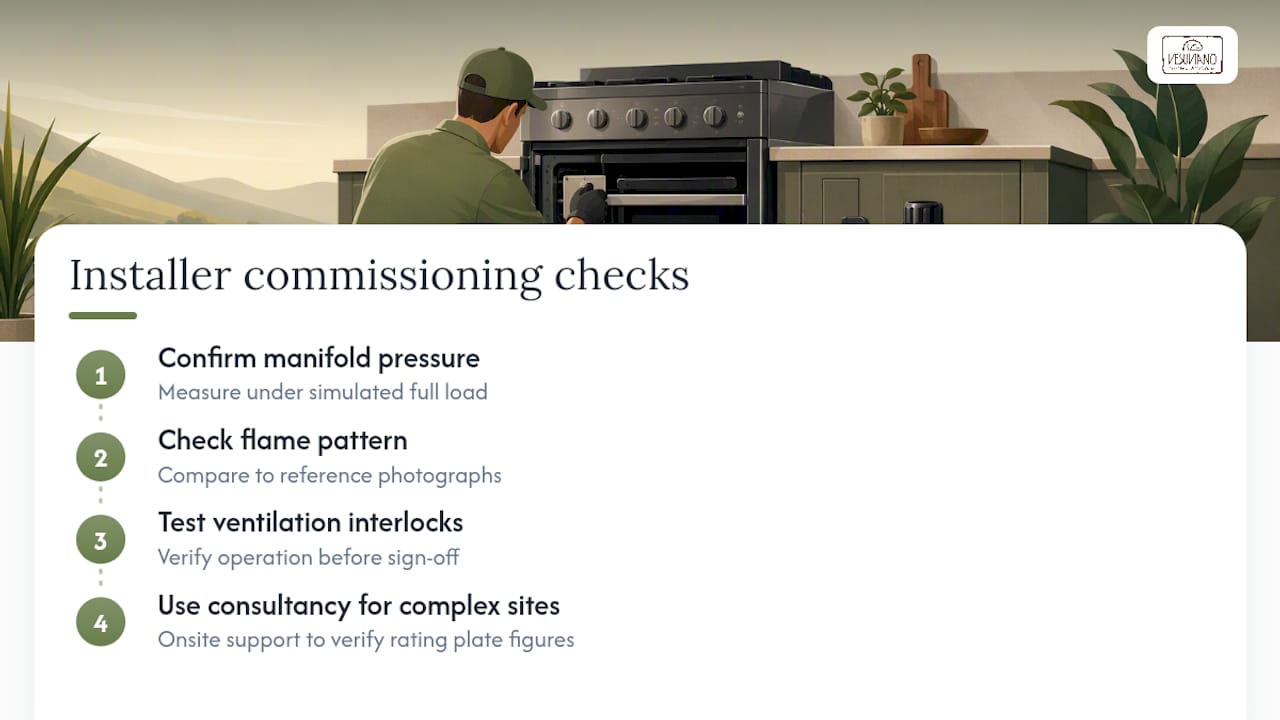
This is where system-level commissioning earns its place in the process rather than being treated as a formality. A competent engineer, ideally Gas Safe registered for UK installations, should check the following under simulated full load, not just at standby:
- Manifold pressure measured with the oven running at maximum output, not idle.
- Regulator kg/h capacity confirmed against the oven’s actual heat input, with margin for future equipment.
- Meter capacity checked against total connected load, particularly in kitchens adding a pizza oven to an existing gas supply.
- Pipework diameter and run length verified, since long or narrow runs create disproportionate pressure drop.
- Ventilation and any flame supervision or interlock wiring tested for correct function before handover.
Record every reading. A written commissioning record, including manifold pressure under load, injector sizes and regulator model, becomes essential evidence if an inspector questions the installation later, and it is the fastest way to diagnose an intermittent starvation fault months down the line. Our own installation guidance walks through this process in more depth for anyone specifying a new commercial kitchen.
What happens if the gas pressure is wrong?
Incorrect pressure, whether too high or too low, changes the air to gas ratio at the burner and that has direct safety consequences. Excess pressure pushes too much gas through the injector, producing a lazy, yellow-tipped flame that signals incomplete combustion and elevated carbon monoxide output. Insufficient pressure starves the burner, causing lifting flames, poor ignition, and uneven heat that will show up as inconsistent basing and colouring on your pizzas long before anyone notices a safety issue.
Ventilation and interlocks exist precisely to catch the failure modes that pressure alone will not prevent:
- A carbon monoxide alarm is a useful back-up, but HSE guidance is clear that it is not a substitute for correct installation, adequate ventilation and functioning flame supervision devices.
- Interlocks that tie ventilation extraction to the gas supply should be tested as part of every commissioning visit, not assumed to work because they were wired correctly on day one.
Regulators typically carry a manufacturer-recommended service life, after which replacement is advised regardless of apparent condition — check the datasheet supplied with your specific model, since intervals vary by brand and duty cycle. Build a routine maintenance schedule around three tasks: a soap leak test at every hose reconnection, a visual inspection of hose condition monthly, and a full flame pattern check whenever the oven is serviced. Our safety procedures checklist sets out a workable maintenance rhythm for busy kitchens.
What our artisans and engineers confirm on every commission
Nominal pressure and injector sizing are specified together, because one without the other produces an oven that lights but never cooks consistently. Installers confirm manifold pressure under simulated full load, check flame pattern against reference photographs, and test ventilation interlocks before signing off. For complex or high-volume sites, technical consultancy and onsite commissioning support help installers verify every figure against the rating plate rather than relying on assumption.
A short word on getting this right
Safety and performance are not competing priorities. A certified regulator and a competently commissioned system deliver both, provided you schedule maintenance and keep a written record of every pressure check.
— Bruno - Key Account & Export Manager
Getting your installation professionally commissioned
Specifying the correct nominal pressure is only useful if the rest of the installation is built to match it, and on-site expertise can make the difference between an oven that performs on paper and one that performs every service. Our artisans and technical team support installations from initial oven selection through to on-site construction and commissioning, so pressure, injector sizing and ventilation are verified together rather than left to chance.
Whether you are specifying a traditional Real Bosco oven, a gas-fired Sebastian model, or a low-emission VesuvioBuono system, our team can advise on the exact regulator, hose and commissioning sequence your site needs before installation day. If your project involves a bespoke build or a complex kitchen retrofit, our on-site construction service manages the technical planning and installation directly, with our specialists on hand throughout. Get in touch with our team to discuss your oven specification and commissioning requirements before you order any equipment.
Key standards, regulations and manuals to consult
For compliance detail beyond this guide, consult GOV.UK gas appliance safety regulations, HSE catering guidance, BS EN 16129 for regulator standards, and your oven’s own appliance manual for exact rating plate figures.
Sources
FAQ
What happens if gas pressure is too high?
Excess pressure forces too much gas through the burner injector, producing incomplete combustion, a yellow-tipped flame, and elevated carbon monoxide output. It can also overload the burner and damage components not rated for the extra flow, which is why matching regulator outlet pressure to the rating plate is non-negotiable.
What gas do I need for a pizza oven?
Most commercial pizza ovens run on propane or butane LPG, with the exact requirement stated on the appliance rating plate. Propane typically needs 37 mbar and butane 28–30 mbar, though some appliances certified under I3B/P categories accept either fuel at a flat 30 mbar or 50 mbar.
Is 2 psi gas high pressure for an oven?
Yes. 2 psi is well above the 28–37 mbar range most pizza ovens are designed for, and would require a dedicated second-stage regulator to step it down safely. Never connect an oven’s burner directly to a 2 psi line without the correct regulation stage in between.
How many psi does a propane grill or oven need?
Standard propane appliances, including most pizza ovens, need roughly 0.54 psi, which is the psi equivalent of 37 mbar. Always confirm the exact figure against the appliance rating plate rather than assuming a generic propane pressure applies.
How do I measure and adjust gas pressure safely?
Pressure is measured at a test point on the appliance or regulator using a calibrated manometer, ideally with the burner running at full load. Adjustment should only be carried out by a competent, Gas Safe registered engineer, since altering regulator setpoints outside manufacturer tolerance can void warranty cover and create a safety risk.