Commercial Pizza Oven Installation: 4 Compliance Pillars to Pass AHJ
Commercial Pizza Oven Installation: 4 Compliance Pillars to Pass AHJ
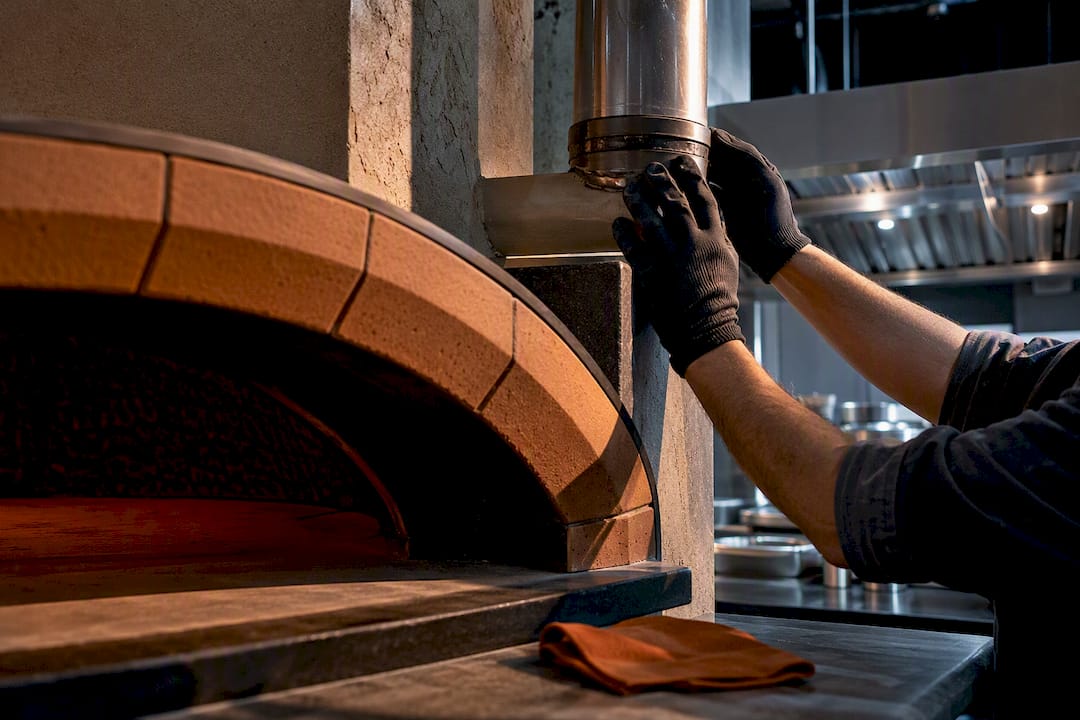
A compliant commercial installation rests on four pillars: a certified structural base rated for the oven’s weight, a Type I exhaust hood meeting NFPA 96 and IMC standards, correctly certified gas or electrical connections, and a documented commissioning process with operator training. Success means your local Authority Having Jurisdiction (AHJ) signs off the hood, exhaust and structural work, every connection is certified, and your team knows how to run the oven safely from day one.
TL;DR:
- A certified structural base and Type I exhaust hood compliant with NFPA 96 are essential for safe, code-approved installation.
- Proper site preparation involves confirming model weight, early coordination with specialists, and securing permits to prevent delays.
- The foundation must handle concentrated loads, be insulated, and routed utilities before slab completion to avoid costly retrofits.
- Ventilation systems require accurate hood sizing, duct construction, and documentation; regular cleaning and airflow testing are critical for compliance.
- Outdoor ovens need weatherproofing, chimney clearance, and protective covers to resist moisture, frost, and UV damage over time.
Table of Contents
- Quick checklist: planning decisions and your installation team
- Site requirements and foundation: loads, footprint and clearances
- Ventilation and fire-safety compliance: hoods, ducts and NFPA 96
- Chimney and flue guidance for wood-fired and gas ovens
- Utilities and connections: gas, electrical and ventilation coordination
- On-site assembly, commissioning and timeline
- Maintenance, cleaning and after-sales support
- Insulation and heat management techniques for optimal oven performance
- Weather protection and durability features for outdoor pizza ovens
- Safety features and emergency shut-off systems specific to pizza ovens
- A note from our export and installation desk
- How Vesuviano Forni supports your installation project
- Sources
- FAQ
Quick checklist: planning decisions and your installation team
Before an oven ever leaves the workshop in Naples, a handful of decisions determine whether delivery day runs smoothly or turns into a costly delay. Get these settled with your supplier and local trades first.
- Confirm the model, fuel type and final weight with your supplier. A wood-fired RealBosco oven has different structural and flue demands than an electric Sebastian model, and your foundation design depends on knowing the exact figure.
- Bring in structural, mechanical/electrical/plumbing (MEP) and ventilation specialists early. Retrofitting a hood system after the slab is poured almost always costs more than designing it in from the outset.
- Apply for permits and, where possible, get pre-acceptance from your local fire and building authorities. Many jurisdictions will review hood and flue drawings before construction starts, which avoids surprises at final inspection.
- Plan site access for craning or skid delivery, plus temporary storage. Neapolitan ovens are heavy and often arrive in sections; narrow doorways, tight loading bays or upper floors need a logistics plan worked out weeks ahead, not on delivery morning.
Early engagement with your local fire marshal is consistently recommended by commercial kitchen ventilation guidance, since local officials often impose requirements beyond national code minimums.
Site requirements and foundation: loads, footprint and clearances
A Neapolitan oven’s dome, hearth and refractory materials can weigh well over a tonne once assembled, so the base has to be engineered, not improvised. Installation manuals for commercial modular ovens consistently call for a reinforced concrete or steel base sized specifically to the oven’s footprint, with insulation layers such as vermiculite concrete built into the assembly sequence rather than added afterwards.
Oversizing the base beyond the oven’s exact dimensions is worth the extra concrete. It gives technicians room to work during servicing and leaves margin for future accessories like proofing stations or a landing counter.
- Design the slab or steel frame to handle concentrated point loads, not just an averaged weight across the floor area.
- Isolate the base from surrounding structure to reduce vibration transfer, particularly on upper floors or over basements.
- Use non-combustible materials for surfaces and structure within the manufacturer’s specified clearance zone.
- Leave clear access on at least one side for ash removal, flue inspection and hood cleaning.
- Route gas, electrical and water services under the floor before the slab is finished. Retrofitting them later means breaking concrete.
Pro Tip: Ask your structural engineer to model the oven as a point load, not a distributed one. Commercial slabs are often calculated for even weight distribution, and a 1.5-tonne oven sitting on a two-metre footprint concentrates stress in a way standard kitchen flooring calculations miss.
Floor finishes around the base matter too. Commercial kitchens generally need slip-resistant, heat-tolerant surfaces, and epoxy flooring systems built for high-heat cooking zones are a practical option for the area surrounding a Neapolitan oven.
Ventilation and fire-safety compliance: hoods, ducts and NFPA 96
Ventilation is where most commercial oven installations run into trouble, because it is the part inspectors scrutinise hardest. NFPA 96 governs Type I hood construction, grease control and cleaning schedules for commercial cooking operations, and it applies whether your oven burns wood, gas or runs on electricity.
Almost every gas-fired or wood-fired Neapolitan oven needs a Type I exhaust hood because of grease, smoke and embers in the exhaust stream. Even high-output electric ovens can require Type I coverage, since hood classification depends on grease output from the menu, not the fuel source. Ventless electric ovens exist, but they are a narrow exception that requires specific certification, not a default assumption.
- Match hood length and CFM to your cooking volume and topping mix; a high-throughput pizzeria running heavy meat toppings needs more exhaust capacity than a Margherita-only operation.
- Coordinate with the International Mechanical Code (IMC) and ASHRAE guidance on duct construction, since welded seams and proper slope are inspected items, not optional extras.
- Consider a pollution control unit where local air-quality rules demand it, particularly for wood-fired ovens in dense urban settings.
- Collect all hood, duct and fan documentation before your final inspection: manufacturer spec sheets, duct construction certificates, and airflow test results.
Most pizzerias generally require professional cleaning of the exhaust system twice a year under NFPA 96 guidance, though higher volume or heavier grease load kitchens may need more frequent cleaning. Coordinate hood-to-fan testing with your ventilation contractor before the oven’s first commissioning burn, not after, so any airflow deficiency gets caught while adjustments are still straightforward. Our own technical notes on NFPA 96 compliance walk through exactly what U.S. AHJs expect to see at sign-off.
Chimney and flue guidance for wood-fired and gas ovens
Flue design separates a smooth inspection from a stalled one. Masonry chimneys built on site give more flexibility for unusual roof lines, but prefabricated flue sections, assembled following the manufacturer’s sequence, are faster to install and easier to certify against a known specification.
- Chimney height and setback need to clear rooflines and neighbouring structures by enough margin to prevent smoke nuisance complaints, a common source of after-the-fact AHJ visits.
- Manufacturer manuals for masonry ovens are explicit about minimum clearances from combustible materials around the entire flue run, not just at the oven itself.
- Low-emission wood-fired systems, such as Vesuviano Forni’s VesuvioBuono range, reduce black soot output but still need a properly sized flue and, in some jurisdictions, a pollution control unit depending on local air-quality rules.
- Photograph and log every clearance measurement during assembly. It becomes your evidence pack for the final inspection and for warranty claims later.
Our detailed guidance on pizza oven chimney height covers the calculation method AHJs tend to ask for when reviewing smoke dispersal.
Utilities and connections: gas, electrical and ventilation coordination
Utility hookups are where trades collide, so sequencing matters as much as the connections themselves. Get this wrong and you will have an electrician and a gas fitter both needing access to the same wall cavity on the same afternoon.
- Confirm gas inlet size, pressure and shut-off placement with your fitter before the oven arrives; Neapolitan ovens with gas assist typically need a dedicated shut-off within reach of the operator, certified by a licensed gas technician.
- Size the electrical feed for the oven’s actual draw, including any auxiliary motors for rotating models, and confirm that earthing and bonding meet local electrical code before power is connected.
- Sequence trades deliberately: structural work first, then gas and electrical rough-in, then hood and duct installation, then final connections and testing.
- Run pressure tests on gas lines, insulation resistance tests on electrical circuits, and an airflow test on the hood before the first commissioning fire, each performed by the licensed trade responsible for that system.
- Document every test result for your AHJ file and to satisfy the terms of your oven’s warranty.
Pro Tip: Schedule the electrical inspection and the gas pressure test on the same day where your jurisdiction allows it. Inspectors often bundle utility sign-offs, and doing both together shaves days off your commissioning timeline.
On-site assembly, commissioning and timeline
Installation day for a handcrafted Neapolitan oven is a coordinated sequence, not a single delivery event. Most commercial installs run across several days once the base is cured and utilities are roughed in.
- Site access and staging. Crane or forklift positioning happens first, particularly for pre-built dome sections; narrow access points may require the oven to arrive disassembled for on-site build.
- Base positioning, then hearth and dome seating. The hearth goes down level and true before the dome sections are set, since a fraction of a degree out of level compounds visibly by the time the chimney is fitted.
- Insulation layering and chimney fit. Vermiculite concrete or insulation blankets go over the dome, followed by chimney assembly and cladding, mirroring the staged sequence manufacturer manuals specify.
- Commissioning checks. Levelling, a gradual heat soak, gas or electrical performance testing and hood airflow verification all happen before the oven is declared ready.
- Operator training and handover. Your team receives documentation and hands-on training, and the oven begins a controlled seasoning and drying period. Manufacturer guidance stresses gradual, staged initial fires here, since rushing the drying process risks cracking the dome.
Maintenance, cleaning and after-sales support
Keeping a commercial installation compliant does not end at handover. NFPA 96 guidance points most moderate-volume pizzerias toward a semi-annual full clean of the hood-to-fan system, with quarterly cleans common for higher-volume kitchens or heavy grease menus.
- Log daily checks (ash removal, visual flue inspection) and weekly checks (door seals, thermometer calibration, hearth condition) so small issues surface before they become downtime.
- Keep hood cleaning records on file. AHJs typically want dated certificates from a certified hood-cleaning contractor, not a self-reported log.
- Book seasonal inspections of the flue and chimney cap, particularly after storm season if the oven sits outdoors.
- Lean on your after-sales support agreement for anything beyond routine cleaning; Vesuviano Forni’s own after-sales support approach is built around cutting the number of emergency service calls a busy kitchen has to make.
Our troubleshooting guide is worth bookmarking for the operator who spots something off between scheduled inspections.
Insulation and heat management techniques for optimal oven performance
Heat retention is the whole point of a Neapolitan dome, and it depends on how the insulation layers are built during assembly, not on the fuel burning inside it. A properly insulated hearth and dome hold cooking temperature around 430 to 480 degrees Celsius with far less fuel input than a poorly insulated equivalent, because heat radiates back into the cooking chamber instead of escaping through the structure.
Vermiculite concrete remains the standard insulating layer between the refractory dome and its outer cladding, and manufacturer assembly guides call for it applied in stages rather than as a single thick pour. Insulation blankets add a further barrier in commercial builds, particularly around the chimney base where heat loss is highest.
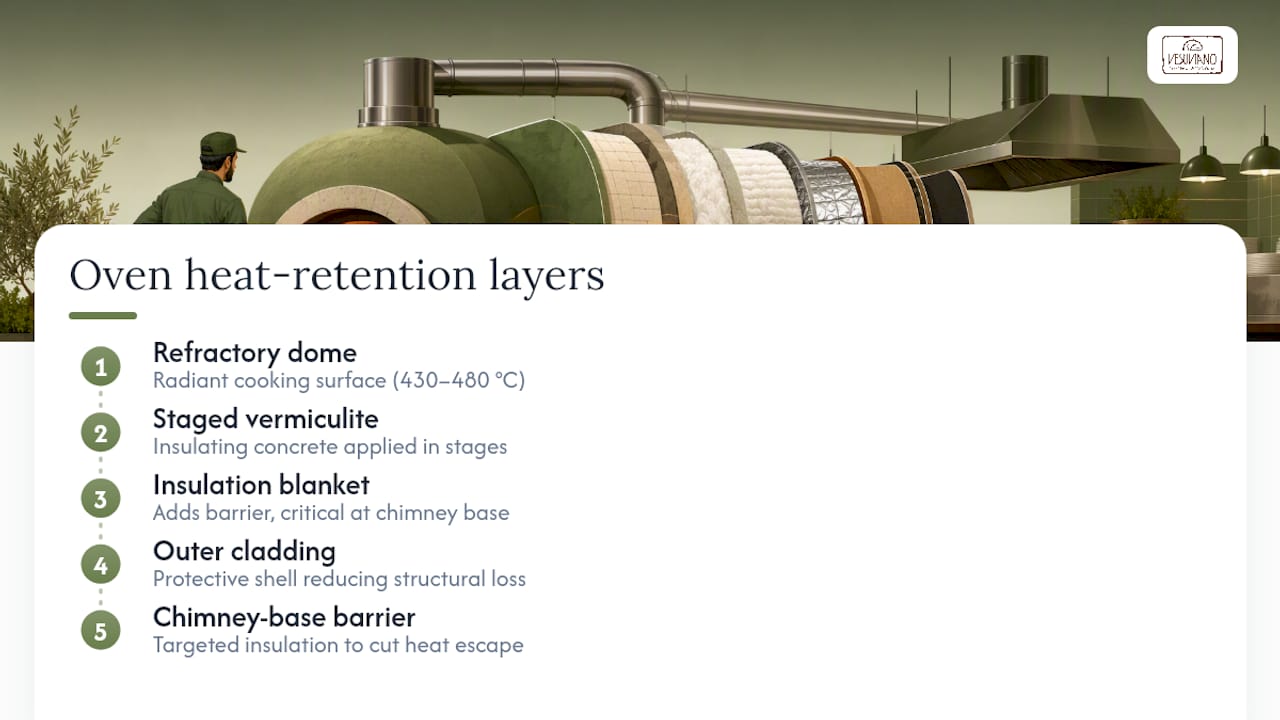
Heat management also depends on operational habits, not just materials. A dome that never fully cools between services holds temperature more evenly, which is why many commercial kitchens run their ovens at a lower idle heat overnight rather than letting them go cold. Rapid heating and cooling cycles stress the refractory material and are the most common cause of premature cracking in busy kitchens.
Door design matters too. A well-fitted oven door reduces heat loss during idle periods and is especially useful for kitchens managing energy costs on gas or electric models, where every degree lost is a degree the burner or element has to replace. For wood-fired ovens, the mass of the hearth stone itself acts as thermal storage, holding residual heat long after the flame has died down, which is part of why a well-built Neapolitan oven can finish a dinner service on stored heat alone.
Weather protection and durability features for outdoor pizza ovens
Outdoor installations face a different durability test than a kitchen-housed oven: sun, rain, frost and humidity all attack materials that an indoor unit never encounters. The refractory dome itself tolerates heat extremely well, but the surrounding structure, cladding, chimney cap and any exposed metalwork need specific protection to last through commercial-grade daily use.
A weatherproof cladding finish, whether traditional mosaic tile or a modern metal-slat exterior, needs to resist both UV degradation and moisture ingress. Water finding its way into the insulation layer is one of the most damaging things that can happen to an outdoor oven, since trapped moisture expands when heated and can crack surrounding masonry over repeated cycles.
A properly fitted chimney cap or rain guard stops water entering the flue directly, which protects both the flue lining and the dome below it during closed periods. For pizzerias in colder climates, protecting gas lines and any electrical components from frost is equally important, and outdoor electrical connections need weatherproof housing rated for the local climate, not standard indoor fittings.
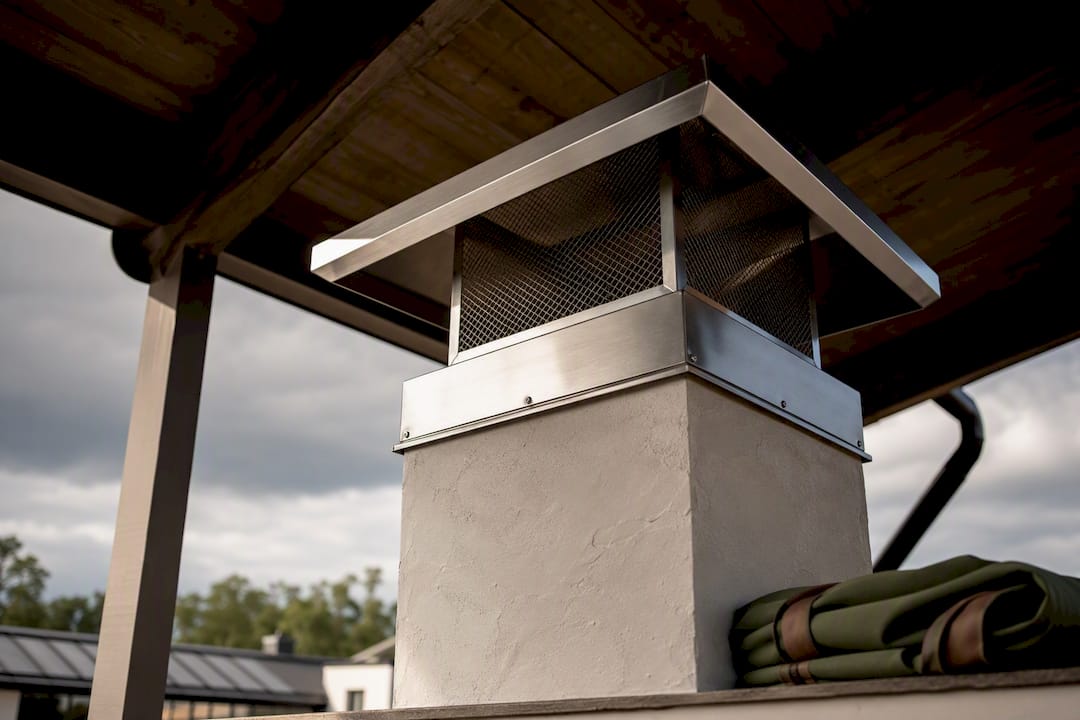
A covered outdoor structure, even a simple roof extension over the oven bay, extends the lifespan of cladding and chimney components considerably compared with a fully exposed installation. Where a full structure is not feasible, a weatherproof cover for closed periods protects the oven mouth and control panel from driving rain and reduces the freeze-thaw cycling that damages masonry over a hard winter.
Safety features and emergency shut-off systems specific to pizza ovens
Commercial ovens need dedicated, accessible shut-off points for every energy source feeding them, positioned where staff can reach them quickly during an emergency, not tucked behind equipment. A gas oven needs a manual shut-off valve within immediate reach of the operator, in addition to any automatic safety valve built into the burner assembly.
Electric and hybrid models need a clearly labelled circuit breaker or isolator switch that cuts power without requiring staff to locate a distant electrical panel under pressure. Thermocouple or flame-failure devices on gas burners are a standard safety feature, automatically cutting gas flow if the flame goes out, which prevents unburned gas accumulating in the cooking chamber.
Staff training matters as much as the hardware itself. An emergency shut-off is only useful if every team member on shift, not just the head pizzaiolo, knows exactly where it is and how to operate it. Include this in your operator handover documentation and revisit it whenever staff turnover brings in new team members.
Fire suppression coordination between the oven and the surrounding hood system is a further layer of protection worth confirming during commissioning. Your hood’s suppression system, where fitted, needs testing alongside the oven’s own shut-off features so that both respond correctly in the event of a flare-up, rather than being commissioned and tested in isolation from each other.
A note from our export and installation desk
Coordinating logistics and installation across international projects teaches you where things actually go wrong. The surprises are rarely dramatic. They are a doorway six centimetres too narrow, a hood contractor who was never told the oven’s true weight, or a site team that assumed the chimney would arrive pre-assembled.
The fix is always the same: measure twice, share the full specification with every trade before delivery, and treat the pre-delivery site survey as non-negotiable rather than a formality.
— Bruno - Key Account & Export Manager
How Vesuviano Forni supports your installation project
Some manufacturers leave many installation steps to chance, but others manage custom oven design, international logistics, on-site assembly, and after-sales support once the oven is running. That end-to-end coverage means one accountable partner from first drawing to first pizza, rather than a manufacturer, a shipper and an installer who have never spoken to each other.
If you are still choosing between fuel types, our wood-fired commercial oven range and electric Neapolitan ovens pages cover the practical differences in hookup requirements and flue needs. For kitchens weighing a signature centrepiece, the rotating oven models are worth a look too. Whichever model fits your kitchen, get in touch with our technical team to request a site survey and a pre-install checklist tailored to your building. It is the single step that prevents most of the delays described above, and it costs you nothing to ask.
Sources
Keep these on hand for AHJ submissions and contractor briefings:
- NFPA 96, Standard for Ventilation Control and Fire Protection of Commercial Cooking Operations (2017)
- Understanding Commercial Kitchen Ventilation Requirements for Pizzeria – Pizza Prep Table
- COMMERCIAL MOLTE KIT STEP BY STEP GUIDE
- Toscana Wood Fired Oven installation manual (Mason-Lite)
FAQ
Does a Neapolitan pizza oven always need a Type I hood?
Almost always, yes. Both wood-fired and gas-fired commercial ovens produce grease-laden smoke that requires Type I ventilation under NFPA 96, and even electric ovens can need one depending on cooking volume.
How often does the exhaust hood need professional cleaning?
Most pizzerias fall under a semi-annual professional cleaning schedule under NFPA 96 guidance, though higher-volume kitchens or heavy grease menus may need quarterly cleans.
Can I install a commercial oven on an existing kitchen floor?
Only if that floor is engineered for the oven’s concentrated point load. Most commercial installations require a purpose-built reinforced slab or steel frame rather than relying on standard kitchen flooring.
How long does a commercial Neapolitan oven installation take?
Once the base is cured and utilities are roughed in, on-site assembly, commissioning and initial seasoning typically span several days, depending on site access and how much of the oven arrives pre-built.
Does Vesuviano Forni handle installation directly?
Yes. Some manufacturers provide custom design, international logistics, on-site assembly and after-sales support as part of an end-to-end service for commercial buyers, backed by technical guidance drawn from decades of experience.